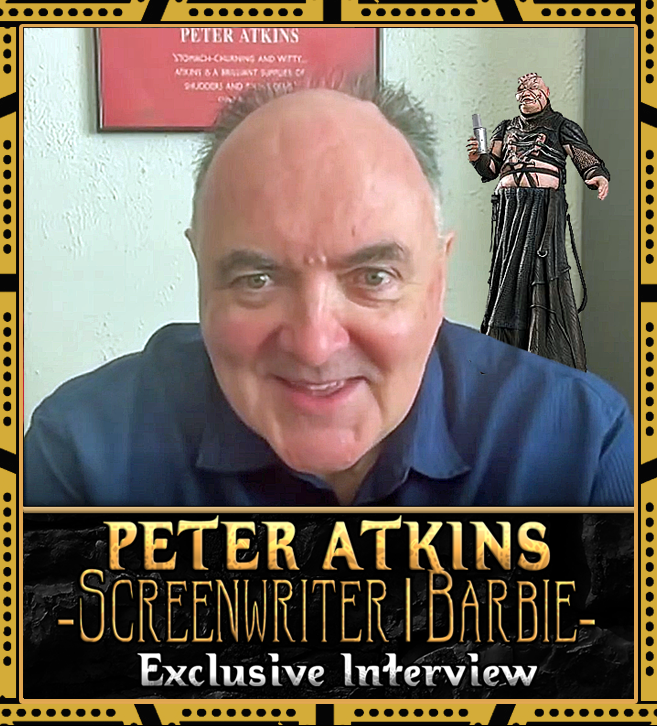
Peter Atkins | Screenwriter / Barbie – Exclusive Written Interview
We had the honour and pleasure of sitting down with Peter Atkins – the visionary writer and screenwriter behind Hellbound: Hellraiser II, Hellraiser III: Hell on Earth and Hellraiser: Bloodline – for an in-depth conversation exploring the franchise’s lore, behind-the-scenes stories, long-standing fan questions, and his infernal performance as Rick Bloodstone, the Barbie Pseudo-Cenobite.
—
“What kind of Cenobite is this cunt? He can’t even step over a fucking wall!”
—

A real puzzle box lands on your desk – do you open it?

Now when you say real, you mean, a box that would open with poor and serious eternal torment and wisdom. yeah, you know I was never quite convinced by that even when I was helping write the stuff – it was like really? Because this looks like it fucking hurts but erm, no, I think that is the short and honest answer – I wouldn’t touch it with a barge pole – Are you insane!?
Even if they said “no, we guarantee there’s as much pleasure as there is pain” and even if they guaranteed there was going to be metaphysical insight and wisdom. I’m a coward and uh, it would be like no, no I’m not. it’s you know It’s like asking If you got an opportunity to jump out of a plane knowing there was a parachute on, yeah you could do that if you’re an idiot, but I mean I’m not gonna jump out of a fucking plane.
So sadly, I know this will diminish my ranking in in the Hellraiser creators league – But no, I know myself well enough to assume that as fascinated as I might be I very much doubt it . Well, you said touch it. I might give it a quick poke, quick tap! See if it’s hot.
See if you see if you can hear the howling of the souls in the Labyrinth coming through – I would really like to have somebody else around urging me to do it because then if I did it – it is not hands that call us, It is desire – and they take them instead of me.
How did you first get involved with the Hellraiser franchise? Did you call in a favour with Clive, or was it vice-versa?
How much money would have I have had to advance him or from what scandals would I have had to save him from to be able to call in a big enough favour of a “I’ve never written a movie before, can I write one?” No, I wouldn’t say I was doing him a favour. Clive and Chris Figg who was his producing partner, Chris Figg – the man without whom Hellraiser probably wouldn’t have happened by the way and I always want Chris to get the credit for that. He and Clive had been sort of given the wink by New World that they were happy to do a sequel. Hellraiser had not been released, so New World were kind of gambling that it was going to do well, so it was simply that.
I don’t know if it was a specific project, but Clive was going to do something else. He was never going to write or direct the sequel, and actually as I’ve admitted before, I wasn’t Clive’s first choice.
Despite our 15 year friendship – fucking asshole – It’s kind of like I’m making light of it, but it’s a sad story – the great Michael McDowell, who had written Beetlejuice and was, you know, a very respected horror novelist… I don’t know if he had directed before, but because of the success of Beetlejuice and a couple of other things, and also, like Clive, he was another gay horror creator, so I think there was a sort of…and I use this in complete affection, “jobs for the lads” sort of philosophy. But this is awful because of the decade we’re talking about. Michael’s partner grew very ill around about that time, and I mean they’d never got… Michael didn’t write anything, but they’d had a couple of initial conversations. And I think it was only when Michael said, “You know, I really need to look after my guy.”
Chris and Clive said, “Oh, we’d better find somebody else,” and at that point, finally, Clive said, “Oh, well, my old friend and former creative partner, Peter Atkins, could probably do that.”
That was what it was. They needed somebody to write a sequel, and because of my shared history in theatre with Clive, he recommended me to Chris, and that was it.
I certainly wouldn’t call it me doing him a favour. It’s not what you know, it’s who you know, and there’s a sort of negative implication to that. But of course, especially as you know from music, it’s not a negative thing of excluding other people. It’s like, “Well, we’ve got a gig on Thursday and the bass player’s in hospital.” So it was like, “Let’s pick somebody we know who is possibly unlikely to fuck it up for us.” That was basically, I think, the way Chris and Clive thought: “Perhaps he won’t fuck it up.” That was probably the standard to which they hoped I would rise.
What does your typical process look like when you’re writing?
It looks like, ‘Oh, that needs tidying. Oh, I should deposit that cheque. Oh, hang on…’ In other words: avoidance, avoidance, avoidance, avoidance. That’s what my process looks like.
What was your go-to drink while writing Hellraiser sequels – coffee, tea, beer or something entirely different?
Um, sadly, the cocaine days were over. So it would be tea. Tea, because I don’t work… I mean, sometimes if I’ve really fucked up and I’m late for a deadline, I will work at night, but I do not like to work at night. So, yeah, tea would be the standard. Just milk.
Which Hellraiser movie is your personal favourite, and why?
Well, it would be hilarious if I said Judgment wouldn’t it. You’d have to end the interview!
I love Gary, so I would always give a thumbs-up just because it was a Gary Tunnicliffe project. And Gary’s great in it, by the way, as the Auditor.
Obviously, the politic answer is, “Oh, the first one.” And by the way, not just to be politic and polite… Objectively, I think Hellraiser, the original – which I had nothing to do with, you know, other than being a mate who visited the set, kind of thing – I would say Hellraiser, the original, is objectively the best, in the sense, if nothing else, that I think it literally does what it sets out to do most evenly and most consistently from beginning to end.
And even those people who are kind enough to prefer Hellbound to Hellraiser, of whom there are many, I think they would have to admit that it is not as consistently… It’s a big, baggy monster, Hellbound, in a way that Hellraiser isn’t. I mean, obviously I like it. I love it.
Yeah, I mean, objectively, I would say the best one is still arguably the first one. Clearly, my favourite is going to be two, three, or four, isn’t it?
I love Bloodline in a sort of, you know, ruined romance. “They broke my heart. They destroyed my baby, but I still love it,” kind of thing. I met my wife on Three, so again, politics would say, “Oh, well, clearly I should…” And by the way, I was in Cenobite makeup when I met her, which is, well… *laughs*
But probably Hellbound. I mean, you know, it was Hellbound because, leaving aside quality or lack thereof, experientially it would be Hellbound because it was my first movie. I mean, other than the 16mm stuff we’d made with the Dog Company 15 years earlier, it was my first movie, and we shot it at Pinewood, which, for a movie buff, was just fantastic.
I arrive at Pinewood. I go through the famous gates with Arthur Rank’s gong-banger logo on the outside, and then I walk towards the place where I know Chris has set up the Film Futures offices for the shoot, and I walk down the middle of Gotham fucking City because the Tim Burton Batman sets are still up. It’s like, “Fucking hell, I’m in the movie business now.”
So that was great. So I guess that, experientially, it was… It was that and it’s the best of the three movies that I wrote. (Hellbound).
Have you actively avoided Hellraiser: Inferno through to Hellraiser: Judgment for any particular reasons?
Yes, I was mad at them! I guess looking back, it seems weird that I didn’t check them out, which I didn’t.
Which one was Ashley actually in? The sixth one, Hellseeker? Okay. I think I felt obliged to see that because Ash came back and that’s the one with Craig Sheffer as well, is it? Or was that…?That was Inferno. Okay, because I’d known Craig from Nightbreed. And obviously… I was about to say, “So I visited the set to say hi to Craig.” That sounds very disrespectful to Doug because, of course, I was visiting the set to say hello to Doug anyway.
But I guess, looking back, there must have been a kind of unconscious resentment. I mean, not that I was jealous or wanted to do them – they were… not to get lost in the weeds on this, but they were non-union movies, which meant that, as what they call a vested member of the Writers Guild of America, I literally wouldn’t have been allowed to take the job because Miramax, cheap-ass bastards that they were, were making them as a non-guild thing.
Also, of course – again, I know this won’t be new to you or your viewers -by that stage, Miramax fucking hated me, and I fucking hated them.But, you know, because I know Scott Derrickson directed Inferno. Obviously, he wasn’t yet thee Scott Derrickson, but I’m sure, therefore, Inferno looks really good – probably a good-looking movie.
But yeah, I guess there was a kind of unconscious, “Oh, fuck them. I’m done with that,” kind of thing.
I was, as I’ve said before, very glad that Doug had a steady payday, and he did Five, Six, Seven, and Eight. I was just channel-hopping about 20 years ago and thought, “Oh, fucking hell, it’s Pinhead. Look…” So I did accidentally see half of that one (Hellworld).
And again, for all I know they’re all great. I’m not saying they’re bad. I’m just saying it’s kind of like an old girlfriend or boyfriend, you know? It’s like, “Oh, I’m done with that one.”
What is your favourite memory from working on the Hellraiser franchise? Bonus points if you can give us a moment from all 3 movies you worked on!
Well, now what kind of idiot do you think I am? As I said, I met my wife on Hellraiser III, so obviously that was my favourite moment.
You know, weirdly, I mean, they’re all just little personal anecdotal things, which I’m happy to give you a couple of examples of, but there’s not a sort of big, you know, revelatory, “Yeah, I realised what the essence of the Hellraiser mythos was.” It was more like I got a real sense of, how petty – well, of how human things are.
it was just… it was a low camera, high set, with Kenneth Cranham just doing a couple of lines. They were just getting the angle, Tony Randel was getting the angle on Ken, so… Mike and Ro got to watch Ken do this, and then, on the good take, when it was clear that Ken had just nailed the line – it was a perfect delivery -as soon as Tony yelled, “Cut,” Ken dropped character and turned immediately to where Ro was standing and gave her a wink. And she just giggled with delight. It was so sweet of Ken to do, you know, because I’d just introduced him. He didn’t know who she was, but it was just such a nice thing to do.
And then, I also got to go and have a chat with Cliff Culley, who did our fantastic glass shots for Hellbound. You know, the… Sorry if it disillusions anybody, but we didn’t actually build the Labyrinth – it was painted on glass. It’s movie magic. But Cliff Culley painted them for us, and Cliff had been in the business awhile. He’d done James Bond movies, and just to have a chat with him about working on James Bond and working with Michael Powell was great.
I got to play a Cenobite in Three, so obviously that meant a lot. because having been a movie monster… You know, having bought my first issue of Famous Monsters of Filmland when I was eight, the thrill of thinking, “Boy, if I could… if I could reach my eight-year-old self and say, ‘One day you’ll be in Famous Monsters of Filmland‘…” Well, not that famous, but you’ll be associated with an even more famous one – that would have been lovely for that eight-year-old me to know.
Things like that. And the joy of hearing great actors make your shit sound good is always a nice memory.
Given the wide breadth of acting experience and the mix of generations among the cast from movies – II through IV, did the actors contribute much during the process – from read-throughs and rehearsals to on-set moments where they might have felt an alternate idea was worth discussing?
Well… I want to answer very carefully because I don’t want to sound… I don’t want it to sound insulting.
I’ll speak for the first four movies. We were very lucky in the sense that we didn’t have any weird grandstanding, “Let me improvise,” actors. They understood that this was a text they had to learn, and they had to deliver the fucking lines, not make some shit up. And, you know, we had a bunch of very professional people.
This is probably just me being overprotective, but when you say in terms of contributing to the script, I mean, in that sense, nobody did.
If you mean, did they bring the thing to life and make it sing? Yeah, I mean, again, I think we were remarkably lucky.
I mean, I think Clive was lucky in the first one, and I was lucky, you know, and Tony, who directed the second one, we were lucky enough to inherit Doug and Claire… I was going to say Clive, Doug, and Claire and Ken, and Simon and Nick, of course. But, you know, Simon and Nick didn’t have dialogue, so they wouldn’t necessarily interpret the script, though, you know, again, physicality is a very important part of the actor’s craft, as we know.
But what I was really thinking of, I guess, was people of the calibre of Claire and Ken, because… Doug was an old horror movie fan. I was an old horror movie fan. Clive’s an old horror movie fan. Ken and Claire were, like, serious actors. You know, Claire went on, as you know, to have a great career at the RSC – that’s the Royal Shakespeare Company for our American viewers. So the fact that they, who I’m guessing would probably have had a kind of knee-jerk, not contempt, but the, “Oh, I’m making a horror movie. Isn’t that silly?”… They didn’t bring any of that. They brought complete commitment and seriousness to the roles they were playing, and they both really went for it.
I can’t put words in their mouths. I don’t know if they would use phrases like this, but I think rather than condescend to, “Oh, we’re doing silly monster movies,” I think they realised that movies of the fantastic – just like literature of the fantastic, or theatre of the fantastic, or whatever – is essentially operatic rather than prosaic. So they knew to pitch it correctly, to commit, to take it seriously, to not go overboard. Neither of them camped it up at any point, obviously, but I think especially with Hellbound, I think they instinctively recognised the kind of operatic level of it. This is stylised. This is heightened. And they accepted that challenge.
And this is also true of the actors in Three and Four, but by then I was an old hand and expected no less than that. Whereas in Hellbound, it was like, “Wow, look at these people go. This is fucking great.”
You’ve long agreed that Larry shouldn’t have ever been in Hell – he was too vanilla for that! Can you recall Clive’s reasoning for why he was originally included in Hellbound: Hellraiser II and why you personally had to push back on the prospect?
Uh, yes, absolutely. Just for clarity…
Because I finally met Andrew Robinson a couple of years ago in Las Vegas, who was a fantastic guy and, the Scorpio Killer from Dirty Harry. Jesus Christ.
So I just want to clarify: I didn’t push back in the sense of saying I didn’t want Larry to be in the movie. I argued, thematically and narratively, that it was wrong. I mean, it’s cute that you say he was too vanilla. I mean, that’s true. I usually put it more that he hadn’t done anything to deserve being in Hell. That was my big thing. Like, “Why is he in Hell? This is nonsense.” And the truth… the answer to that question, I don’t want to put words in Clive’s mouth, even though we’ve spent 50 years putting words in each other’s fucking mouths…
The truth is, it wasn’t necessarily a lofty or artistic reason. They wanted the cast back from the first movie. He was, I believe – I do not know this because once we were arguing about it, it just became an intellectual argument, not a pragmatic one – but I don’t believe it was for lofty artistic reasons. I think it was just like, “Well, of course we can get Andrew back. We were using him, you know.”
And the only reason Andrew isn’t in Hellbound, and the only reason Larry isn’t in Hell, is not because fucking Pete got it up his ass saying Larry shouldn’t be in Hell. Larry wasn’t a bad man. It was because and I believe Andrew has said this out loud, so I don’t think I’m telling anything out of school – they just nickel-and-dimed him. They lowballed him. They wanted to pay him less than they paid him for the first movie, which is fucking outrageous. So he and his agent quite rightly said, “Fuck off.”
And I’d like to say I had no glee in the fact that, “Oh, I guess I’m not going to get to meet the Scorpio Killer from Dirty Harry.” But I was pleased. Even though it meant a very fast rewrite – we were only two weeks from fucking shooting – I was pleased. I thought, “This is better. It’s Frank’s filthy scheme. He’s luring Kirsty into Hell.”
Was Channard originally going to be operating as his own entity before he was commandeered/controlled by Leviathan? Did the penile-attachment ever come with a deeper meaning or thought process to explain that Channard was seemingly being puppeteered?
The herpes penis. What did Jeff and the lads call it? The… the something… ‘cock from Hell.’ I can’t remember.” Yes, there’s very little doubt about the imagistic origins of that thing that is attached to Ken.
I was about to automatically say he was always Leviathan’s puppet, but that sounds very judgy about the lack of will in Channard. And, of course, you know, a lot of people’s favourite Channard line is, “To think… I hesitated.”
So it’s important that we know he did get what he wanted. You know, his whole mantra of, “I have to see. I have to know.” Which Julia, the bitch, undercuts with, “Well, he wanted to see. He wanted to know.” How great is Claire when she delivers that? When she says, “Now you know,” it’s like, “Oh, God…”
So, yes, Channard was self-driven, self-motivated, and certainly got what he wanted. But yes, we’d always assumed, again… as I think most Hardcore Hellraiser fans know, because I’ve babbled about it many, many times, the basic story of Hellbound was cobbled together one night at Clive’s flat in London by him and me – and I should put him first – by him and me and a bottle of whiskey. So I think by the time we got to 11 o’clock at night and the whisky bottle was almost empty…”He’s fucking swinging from a giant cock from Hell!” We did not say that. That is not what we said. But it was always, I think, a sort of imagistic thing. We just thought, “How cool will this look?”
I’m trying to remember what we were really seeing visually then because, again, as I said before, Leviathan was originally visualised, in that drunken evening, as a big sort of oozy Lovecraftian beastie in a pit and we literally had = you know, the treatments I wrote after that session -and I think they might have picked this up and used it in the comic books later. I’m not sure. But he was literally sort of making Cenobites in the sense of, like, spitting them out of his big oozy self.
I think it was described that way both in the treatment and in my first draft because even in the first draft of the screenplay, he was still a big Lovecraftian gloop monster. But the neat, beautiful, geometric Leviathan really came about once I was working with Tony. Once Tony came on board – I guess I’d done three drafts – and then Tony came on as director. He and I got on immediately, and…I mean, I was very willing to go with it. I was a, you know, willing collaborator, as they used to say about Nazis friends. But I think that sort of ordered, geometric thing – that was Tony’s science fiction background coming through because he likes horror movies, but he was more a science fiction guy.
So I think that notion… Again, I don’t want to put words in his mouth because, again, you’re sitting in a hotel room just shooting shit back and forth, you know. But I think that machine-like nature was something that would not necessarily have come about had he not come on board. And I think he talked about machine-like… He’d made comparisons with just the look of the Labyrinth. In his head, he wanted it to look like Forbidden Planet, the landscapes in Forbidden Planet that have that kind of Escher-like plane. So when he said “mechanical”… Again, I don’t know who said what. One of us will have said “mechanical,” and the other will have said, “It could be a fucking box or something,” which sounds like me. At that point, the spewing-Cenobites notion disappeared.
So Channard being tentacle-ised, or cockified, or whatever verb we want to use, was a sort of hangover of Leviathan literally making the Cenobites. We’d have to get some future academic have to look at the various drafts of my treatments and screenplays to see at what point we actually connected him physically, and to me… I know that, in my head, I assumed – and it is open to interpretation. Just because the writer of the screenplay thinks something, you don’t have to agree.
I assumed that the Cenobites had as much self-motivation as the other Cenobites do. They all serve the great dark god, but they have individual will.
But as you can tell from the hammy lines I gave him – older, jokey, “The doctor is in,” “No anaesthetic at hand,” all that stuff – he is having a delightful time.
So yeah, it’s not like those lines are being spoken through a puppet by Leviathan. That is the transformed Doctor Channard rubbing his evil mad scientist hands with metaphysical glee, so there is still a sort of self-determined thing.
But, you know, then Leviathan rips his head in half, so… Talk about being spurned by the thing you love. It’s a terrible, terrible thing.
Why did Leviathan abruptly decapitate Channard? Was it a direct result of Tiffany opening the configuration within the Labyrinth, Channard serving his purpose or something more sinister?
Again, see, the problem is you guys think that we think these things through. We do not. We make them up on the spot, and if they serve the story… That’s a somewhat flippant answer, but it is also somewhat true. You don’t necessarily think, “How does this work with Hell’s logic as established in the charter documents?” Blah, blah, blah. It’s an organic process rather than an intellectual process.
But I would say my assumption – and again, it’s not like I watch these movies as often as you guys do, so I’d have to watch it again – but I believe that my feeling, and I think this was what the cast and crew and director assumed as a consequence of the script, is…
It was Tiffany. Tiffany had, from our human point of view, put it right. From Hell’s point of view, she’d fucked it all up.
It just seemed like the consequence of the disaster of solving the box, and therefore closing the big box, that Leviathan was like, “You know, sorry, Doc. You had a brief run as a Cenobite, but it’s all over now because, you know, the good girls have won.”
It’s interesting, isn’t it? I mean, if we use horror movie nomenclature, is Kirsty the Final Girl, or is Tiffany the Final Girl? Obviously Kirsty’s the heroine. Kirsty’s the protagonist. But… This has never occurred to me before, by the way. I’m just literally thinking out loud. In a way, Tiffany’s skill… Tiffany closes the box, you know, in every sort of metaphoric as well as narrative sense. I guess, as usual, we were so ahead of our time – We had two Final Girls.
So yes, I think it was a consequence of the temporary foiling of Hell’s plans. Leviathan closed up, became the Lament Configuration, Channard lost half his head… I mean, Leviathan was confused and hurt because that fucking Kirsty had reminded the other Cenobites that they were human and allowed them to be destroyed.
You know, so all in all… it wasn’t a good day for Hell. It was a sad day. A sad day for Hell.
What happens to a denizen of Hell when they are ‘killed’ again? In particular, what happens to Frank once Julia tears out his heart?
Which answer would you like? *Laughs*
But obviously the important thing for me, emotionally, thematically, and narratively, was that Julia got to rip the fucker’s heart out and deliver his line back to him: “Nothing personal, babe.” Which, you know, just in case it’s not clear… of course it’s fucking personal, babe. That’s the whole point of that. I have to admit, genuinely, it never even occurred to me to think, “What does that mean for Frank at this point?”
Obviously you’re right. He is a supernatural creature in a supernatural realm. What are the rules? I have disappointingly revealed to you, I don’t know what the fucking rules are, mate.
In my head, he’s done. He’s done. If you’re killed in Hell, there is no further plane. That’s it. You’re in trouble. It’s like, once you’re gone, you’re gone. Especially if, you know, the future Queen of Hell – which is what Julia is angling to be and become – if she wants you’re gone, you’re gone. So that is my assumption. It’s like, if you’re dead here, that’s it.
Or we can look kindly on this sad world of mortals and their metaphysical games, and we can just assume that, at that point, whatever the true essence of Frank was rises to be subsumed into the cosmic oneness into which, one day, we all will be subsumed…
What was the reasoning behind the Order of the Gash being so easily dispatched by Channard? Was this a reflection of Leviathan’s sheer power, or did them remembering their human lives weaken them?
I never thought of the ‘victory’ being Channard’s. It was Kirsty’s. She had reminded them of their humanity. Humanity equals weakness in the Labyrinth. So Channard – who had so recently and so gleefully given up his own humanity – could dispatch them with an ease that wouldn’t have been possible in their full Cenobitic forms.
What happened to them after their ‘deaths’? Were they demoted to a lower Order? Exiled to another plane of existence to languish or perhaps outright eliminated?
As to what happened afterwards? Well, Life and Death have their mysteries, and the World has only guesses… *Laughs*
What happened to Pinhead is the whole plot of Hell On Earth. The other three, like Frank, were no doubt subsumed into the Cosmic Oneness.
What actually happened to Julia after she was sucked away in that hallway vacuum?
Is that where the skin is pulled off? I mean, there’s big winds blowing…
You’re right that it seems odd now because, at the end of the movie, what comes out of the mattress is the Pillar of Souls. But what was meant to come out of the mattress was the Queen of Hell – the new Empress of Hell.
So the fact that Julia had been damaged in the chaos unleashed in Hell by Kirsty and Tiffany’s victory wouldn’t have seemed so… “Oh my God, what happened to Julia?”
Because if we’d had that ending, it would have been, “Okay, Hell reset itself. Leviathan rewarded her for her sterling work,” and she would emerge from the mattress as, literally, Hell on Earth in number Three because we already had that title.
But until you said it, it doesn’t occur to me that without her coming… Obviously, I regretted that we didn’t have Julia move forward through the series, but it had never occurred to me that it’s like, “Oh… is she dead? Where’d she go? What happened?”
Because you would never have asked that question if she’d come out of the mattress, you know what I mean? Again, it wouldn’t necessarily have made logical sense, but we’re talking about supernatural horror-movie theatre. They don’t make logical sense. But it would have made thematic, narrative, and emotional sense. It’s like, “Oh yeah, okay, so she disappeared down a corridor, but look… she’s back, and she’s glorious.”
And you’re right. It is a sort of jarring, almost, because it just feels like she’s written out and therefore… Because, and again, none of this is pointed… she wrote herself out. Yeah, she decided she wasn’t going to do it. So we had to do that reshoot of the Pillar, which, of course, gave us the whole impetus for what became the story of Hellraiser III.
Oh yeah, it wasn’t a total loss. But, you know, I’m sad. And you’re right that that does mean this character, whose revenge and ascent to power we’ve watched through the two movies, just kind of disappears.
And actually, until you put it that way – seriously – I hadn’t really registered that because, I guess, in my head, there was… you know, you carry that alternative ending in your head anyway. So I didn’t feel the, “Oh, she just vanished.” So now, theoretically, we have to go back and re-canonise why that actually happened, or what happened to her. You see, I think we’re in a quantum universe. I think we’re in a quantum Hell.
So I choose to believe that, in the other timeline – not the one that we shot the movies in, but in the other timeline – Julia was the Queen of Hell, and she did come back, and she was Hell on Earth.
And they won. She won. We now all serve the Labyrinth. We all serve Leviathan.
Why do you feel Julia never had any interaction with the Cenobites, even when both were present in the Labyrinth?
Yeah, let me get my ducks in a row as I try to pretend we knew what we were doing. Well, she doesn’t interact with the Cenobites, but… it never occurred to me until your question.
No, she was not consciously avoiding them. But she is tricking, luring Channard, so I had no conscious thought of, “We’ve got to keep her away from the Cenobites.” It’s separate. I think that is sort of an accident of camera-angle-ness. She perhaps wouldn’t want him to see the Cenobites at that point, but he’s seen them. I mean, he and Julia are literally there while the Cenobites are with Tiffany. But that’s not her job. Her job is to bring the doctor in, give him what he wants.
So I’m genuinely not avoiding the question. But it was literally an, “Oh, that wasn’t conscious.” It was like the Cenobites had their narrative strand, and Julia and Channard had their narrative strand, and we were moving them to the next scene where she could take him to the, you know… the cabinet of transformation, or whatever it is.
I don’t believe there was any conscious decision to, “Don’t make eye contact with them…” Because, I mean, I don’t think there’s… it doesn’t… there’s no consequence to that, right? I haven’t watched the movie for a long time… she leads Channard… The portals have been opened because it is desire that has called them. So he’s going to go to Hell, and unlike in the first movie… I mean, this is partly why we called the movie Hellbound. It’s like, well, this time we’re going in. So we get to see the consequences of what desire does if the portal opens. So I certainly – and I think I’m speaking for the producers and the cast and crew, though I don’t know…
There was no ulterior motive or anything significant about that, other than she had a job to do, and that was the job she was doing. Is there something specific that makes viewers think, “Oh, she can’t see them,” or “They’re not looking at her”? What is it that prompts the question specifically?
So I think she never had any need for therm. The sort of “Bride of Leviathan” – That’s great.
What was actually shot of Julia in the black dress at the end of Hellbound: Hellraiser II? There seems to be one frame that exists with her in that version of the dress.
Yeah, and it wasn’t just that I wrote it – we filmed it. It was never processed and finished, but we had Clare elevate magnificently. I assume she was on wires – I literally can’t remember – against the green screen.
But Oliver Parker, another alum of the Dog Company, was sucked into the mattress. The removal man from both movies. And Julia would emerge in… and I think, by the way, that was literally the line in the screenplay because I didn’t try and tart it up. I just said… “in a fabulous black dress.” I think it literally says something like that. “I’m Julia, love me.”
Now, again, I don’t know if Tony shot that. We definitely shot Clare coming out of the mattress. And then, theoretically, there would be probably a post-production optical zoom into Clare’s eyes. You know, Hell would burn behind them, run credits, or whatever.
Oh, the black beam of light! That was good, we should’ve done that!
How did you envision the story unfolding if Clare Higgins had returned for Hellraiser III: Hell On Earth? Did you have any moments or scenes mapped out in your mind?
As you know, the intent was that it was going to be her series. Which, you know, Doug was bridling his ass when we remind him of this, but… and I don’t just mean it was me. It was Clive and Chris’s idea that Julia would be the continuing character. That was probably Clive’s mistake. I think probably he or Chris – because we’d said it lightly, you know, they were just joking – but we’d say, “Yeah, she’s a female Freddy. She’s going to be our female Freddy.”
And I have long suspected that one of those morons said specifically to Clare, “You’ll be our female Freddy,” at which point Clare quite rightly thought, “Fuck that. I’m off to the RSC. I’m going to play Cleopatra. Fuck you.”
Any idea why another woman was used for human Female instead of Barbie Wilde?
The can of worms you’re opening here, is what drives Nick and Barbie… I don’t think it bothers Simon so much, but Nick and Barbie really resent that to this day.
It is nothing more than dull pragmatism. it was being shot on the same day. I don’t know how often you’ve got in and out of a Cenobite costume, but let me assure you… well, yeah, I bet it’s not “none,” *Laughs*
But let me assure you, it’s not like changing a jacket, you know what I mean Fortunately, I can wipe my hands of this because this is a production question, so I can blame Tony Randel. There was no fucking way they were going to triple the shooting time to wait for Barbie and Nick to be divested of their costumes because the makeup application and removal is serious time.
I think eventually Gary J, Tunnicliffe got Doug’s Pinhead application – he boasts about this – down to, I think, 90 minutes or two hours. But on Hellraiser and Hellbound, when Geoff was doing it, I think it was like three and a half hours for Doug and almost as long for the others. So it was just pragmatic. They weren’t going to take them away, dust them down, give them a shower, put the Cenobite costumes back on but without the makeup, and bring them back to set.
I mean, obviously people can say, “Well, you could have shot something else.” Well, yeah, you could if you’re shooting a scene on the street with some handheld cameras. Go and film the conversation in the coffee shop while they reset the burning car outside or whatever. But this is a soundstage. The set is built. We’re doing that on the same day they were still doing scenes as the Female Cenobite and the Chatterer. So it was entirely pragmatic. Certainly in terms of Barbie…
But I’m being a little disingenuous here because I think we had revealed the Chatterer as a child. That was meant to be an “Ooh… he was a boy. Ah… So that was deliberate, and Nick hates us for it, but he’s got 75 alternative fucking backstories for the Chatterer. He’s built an entire fiction-writing career out of it. So he should thank us!
I love Nick, this is all said with humour and affection. He does not hate us. But it did annoy him. It did bother him that he didn’t get to be himself. I mean, it bothered them because Doug did. You know, we got to see Doug’s face. Which, of course, gives the absolute fucking lie to what I just said, doesn’t it?
I do think that was a separate shoot. I think it was either we got everything else done and then brought Doug back sans makeup, or we shot Doug before the makeup.
I assume you ask because Barbie must have said something at some point. I know, like I say, Nick’s bitched about it for decades. *Laughs*
We only see brief glimpses of Tiffany’s mother in flashback-sequences – what events actually unfolded for her and was there a particular motive for Channard?
What’s the phrase? Collateral damage.
Tiffany’s mum was collateral damage because the gift that he saw from the get-go that Tiffany had is what he wanted. He wanted somebody who could open the box for him.
So he casually killed her mother. What a dick. He deserves everything he gets. It’s all poetic justice. You see how this stuff works? We think this shit through, mate.
We did, at one point, talk about whether we needed to show it… Trust me, we would never have wasted more than an extra 45 seconds of screen time on it, but we did wonder how specific and detailed we should be about what happened. We decided we didn’t need to – that people would get it. It was like, “Oh, shit.” So that’s… you know…
How would you describe the relationship between Channard and Tiffany? Some fans do seem to pick up on varying undertones throughout the movie.
What’s wrong with you? He was after her mind, you sick fucks. *Laughs*
I mean, obviously, it is a smart assumption and question, hideous as it is. It genuinely didn’t occur to me, and I think actually… I feel like I’m making a special plea for Channard. I am not being defensive of that monster.
I don’t think he would have… He was after other things. That doesn’t mean that he’s not… You know, he might also be a creepy perv. But I honestly, think… Well, I can say for sure it did not occur to me. I think partly because, when I wrote it, I don’t think -I’m not sure I specified it in the final shooting script – but I think in my head Tiffany was 12 when I first wrote it. I mean, not that that stops paedophile monsters from doing things… But it was a more innocent time. Or maybe I was. But it was not… and I was not naive.
But it honestly did not occur to me, and I don’t think it occurred to anybody else. And I completely understand why audiences – especially people, especially fans who watch the movie more than once – might…
Now that you’ve said it, of course, like all those situations, it just feels entirely implicit, doesn’t it? It’s like, “Well, of course he’s a fucking abuser. Look at it. Look at the body language. Look at how he eye-contacts them.” Yeah, it’s probably all there implicitly. And for all I know, Imogen was both sharper and more perceptive about the awfulness of human nature than I, might have just made that as a character assumption.
I think Tony Randel is as naive and innocent as I am, in the sense that I don’t think there was a subtle direction. Because sometimes you can take actors aside and say, “He molested you when you were 11,” and that really changes the way an actor would play a scene. To the best of my knowledge, no. Not intentional on my part. I see it. I see why. And also, I mean, there is also that thing, as I say, in my head: 12. Not that that sadly protects people in real life from predators, but it kind of removed it from the likely… the likelihood became less likely.
I just remember, I guess because Tiffany was still 12 in my head, I, for my sins, was still a smoker in 1988, and I would step outside the shoot, outside the soundstage, for a ciggy. And at one point Imogen comes out and does a whole sort of… like she’d been exhausted by something. And she walks out and stands next to me and goes, “Oh God, what a fucking day. Can I have a ciggy?” And I only said, “What are you talking about, child? Of course.” And then I thought, “She’s 17. Of course she’d have one.” And I gave her a cigarette. But what that means is I wasn’t thinking of her as a young woman. I was thinking of her as a little girl. Which, you know, I mean, of course 16 or 17 is a little girl, but not… not that.
Yeah, I mean, the fans are probably right to see that, but it was not a plant. Certainly not on my part. I did not assume… I thought he had his weirdness’s. But also, the thing is, he had his weirdnesses, but it takes a beautiful bitch goddess like Julia to really bring the weirdness out of him, because, you know, he’s kind of passive in that relationship. But generally speaking, I agree with you, which I think probably is why it hadn’t occurred to me that this… this fucking brother has got a 12-year-old in his care. So yes, that is a very valid reading. But it was not an intentional subtext.
The blue screaming balls of energy that emit from Leviathan as Kirsty and Tiffany make their final escape – were they freed souls?
Sure. Why not?
I mean, I guess, like, again, the difference between conscious intent and retroactive memory. I think it was more… everything’s going to pieces. Everything’s blowing apart. But, you know, one of them heads straight for camera and it’s a screaming face, right?
Uh, yeah, the early days of CGI… We couldn’t really model that as well as they would do nowadays. Freed souls, or, you know, chaotic…
Well, but I wonder if that was some kind of hangover notion of the thing we talked about earlier, of Leviathan spewing Cenobites, creating Cenobites. That these were the things that were being blown out of Leviathan.
And “freed souls” is an excellent reading, and I think makes more sense given that the good girls have won kind of thing. But they also could be, you know, little embryonic Cenobites that never got to be completed because we just closed the box. I love that. Little screaming skull-face Cenobites.
Would they have harmed the girls had they made physical contact? They did completely obliterate a lampshade and a painting after all!
Yes, good job they didn’t hit them then. I think yeah, it’s always a good idea to physically avoid balls of of infernal energy if one can.
What did/do you visualise for Kirsty and Tiffany’s future after they departed the Channard institute together? Did they go their separate ways? What was in store for them?
Oh, come on, son. I know what you’re asking. *Laughs*
Well, that they went off to a quiet and long lesbian life in a small cottage on the Cornish coast. Is that what you want to hear?
Um, I assumed – kidding aside – I assumed they would, in fact, go their separate ways. Though, again, in my head, Imogen is 17. Tiffany, the literary creation, is younger than that. It’s not like you necessarily visualise a full long-term life for the characters after a narrative ends. But yeah, I assumed Kirsty would somehow be responsible for Tiffany for a period of time.
And given that Imogen was of legal age in the UK, I think I like your implicit assumption that they’ve retired to a long and happy life of lesbian love.
How might the story have unfolded if Rick Bloodstone had been the one to discover the Box instead of Terri or J.P Monroe?
I think this Barbie would have been king of Hell. That’s what would have happened.
I only have a light answer for that. He is a very minor character. Rick Bloodstone only exists so that I could stay on the shoot. So then I just wrote a couple of lines for Rick so that, unlike Barbie, Nick and Simon, I could get my real face on the screen? Ha, no. But that was why Rick’s in the movie, because the Barbed Wire Cenobite is in the movie.
So I don’t think Rick was a great guy. I don’t think he was as bad as JP, but… It would be an interesting test of the man’s character if he had done it first. I don’t know. It’s interesting to speculate.
Miramax picked it up for distribution after we’d finished it, but the small production company that was making Hellraiser III, Transatlantic, had flown me out to North Carolina for pre-production, I think for the three weeks prior to the shoot. But the assumption was that they didn’t have it in the budget to keep me there because, you know, they’re cheap bastards.
But they’d also fired Tony Randel, who was going to be the director originally, and brought Tony Hickox in. fortunately, Tony Hickox and I clicked immediately as well, and he became a friend and long-term colleague. He obviously took the job, but I don’t want to say Tony was nervous because he wasn’t really a nervous sort of fellow, but he was the fucking ELAN being thrown in at the deep end. He said, “You’ve got to let me have Pete. You’ve got to keep Pete here.” And they said, “We don’t have the money.” He said, “Don’t be fucking ridiculous.” And they said, “We’re not, because we don’t have the money.”
So, as a consequence of that, Tony said, “Well, fuck that. He can play one of the Cenobites.”
If Barbie had dialogue or was capable of speaking, what sort of things do you imagine he’d have said and how would you have delivered those lines?
Don’t remind me, don’t remind me. I know there are CDs, and I know there are bad ones – they’re not real Cenobites, everybody. Pseudo-Cenobites, yes. Ersatz Cenobites. Artisanal Cenobites!
To defend myself, Pinhead literally tells you that. He says, “Shadows of my former troops.” So, you know, they really are artisanal in the sense of being handmade. You know, very much trapped in the nineties, in which we made the movie – CDs. Jesus Christ, we thought they were going to last forever!
So it’s a good job, isn’t it, that Barbie cannot speak, because doubtless it would have been awful puns based on, you know, “That’s a wrap,” “Ready for your close-up?” and all those lines.
Presumably Barbie would have had witty come-ons like, “You want ice with that?” You know, just terrible, terrible jokes.
Although now I’m tempted to pull the mask back out of the bag, put it on, and do a little YouTube channel of the things Barbie would have said.
Considering that the artisanal Pseudo-Cenobites were ‘handmade’ by Pinhead, what actually happens when they are captured by the Lament Configuration? Do they arrive at the Labyrinth? Does Leviathan make them into ‘true’ Cenobites?
One can hope so, can’t one? That would be very nice. I think they would all like to qualify.
I think, having had a brief taste of what a pleasure it is to chase Terry Farrell down Elm Street breathing fire, Barbie would certainly say, “This is the life for me.” So yeah, what a sweet thought.
Because you’re right, it’s not like they are killed in our reality. They’re blue-lighted, dragged away, so yeah, they do go to Hell. Yeah, let’s think, for their sake, that they all qualified. Because flunking out of Cenobite boot camp is not good. You don’t want to fail.
I love the fact that they’ll now be called artisanal Cenobites for future Hellraiser scholars. This is great.
In the script, Pinhead’s human name is spelled one way, but it was changed for the movie. What prompted that alteration, and was there an issue with the original spelling? S vs C.
I literally lose track of which way round it was. I know that my intention – my pretentious intention – because, again, I can never remember how much of this stuff survived into the final cut of the movie, but Elliott was a mouthy fellow in most drafts of the screenplay. He had this long history of being part of the Lost Generation, a lost soul from World War I, and he talked about the war poets from World War I – Wilfred Owen and Siegfried Sassoon and all those guys.
So I very consciously gave him the names of two poets: Eliot and Spenser – Edmund Spenser and T. S. Eliot.
The awful admission, especially for a graduate with a Bachelor of Arts in English Literature, is I can’t remember if the spelling mistake was mine and was corrected by the movie people, because I literally can’t remember which way around it was. The intent was always two poets, but I might have spelled Spenser with a C, and I also might have spelled Eliot with two T’s.
The problem is, I think there are drafts of the script in which Elliott has two L’s and two T’s, drafts in which it’s a single L and a single T, drafts in which it’s a single L and a double T, and drafts where it’s Spenser with an S and others where it’s Spencer with a C.
So it’s all my fault. It’s either that I got it right but didn’t insist that those illiterate fuckers making the credits matched my spelling, or – what’s even more humiliating – I got it wrong in the first place.
The spelling should be T. S. Eliot and Edmund Spenser, but there are too many variants out there now. It’s out of my control.
Some fans have speculated that Pinhead’s backstory was expanded in the second and third movies because audiences didn’t fully know who Doug Bradley was after the first movie. Is there any validity to that theory?
I’m trying to avoid using the phrase “audiences didn’t know who Doug Bradley was,” because they certainly do now.
I trust Doug never wastes his time watching this, so it doesn’t matter – but Doug, if you do watch this, I say this with absolute respect and fifty years’ worth of affection. In 1992, when we shot Hellraiser III, no offence, the audience didn’t know who Doug was. They knew Pinhead.
Oh! Oh God, he’s such a drama queen but it wasn’t Doug’s fault. I wanted to know who Elliott was and give him more depth. Was Doug happy to get screen time as Doug? Yeah, absolutely he was.
No, hand on heart. I don’t know what personality quirk of Doug’s has led people to believe he’d be capable of such an egotistical move. How dare they? I simply wanted to know more about Elliott. It was also important to the story we were telling about Joey being haunted by her father. We needed that parallel between Elliott and Joey’s dad – between World War I and Vietnam and all that.
But yes, I’m sure Doug was very happy not to have to put the makeup on all the time.
Can you walk us through the makeup and prosthetic process for when you became Barbie, the Pseudo-Cenobite?
It wasn’t that arduous, sadly. Unlike Pinhead – and I don’t want to imply there was any sort of gradation between the original Fab Four – I think Simon will kill me if I’m wrong about this, but I think Butterball was almost a mask that could simply be pulled on. I don’t know that to be true. Pinhead’s was, as I say, a long application. So was the Female Cenobite’s, and so, I think, was the Chatterer’s. I assume Butterball wasn’t far behind them.
The only reason I make the analogy with Butterball is because Barbie was a mask. In other words, it wasn’t a single application built up piece by piece. I was not in the makeup chair for anything like the three hours Doug would be. It was a pull-on mask, but it wasn’t just the mask. I think it took about half an hour, maybe forty minutes. The mask would go on, and then there were lots of little applications around the eyes and mouth to blend it all together.
So it wasn’t arduous in any way. And also, I’m not a complaining, whining bitch like Doug and the others! They’ve all got this, “Oh my God, the horrors of being attended to in a makeup chair.” Fucking babies.
But I’m sure your patience can be tested when it’s three hours in the morning, because it takes almost as long to take it off. So you do your three hours, work all day, and then you’re back in the chair again for another two hours. That’s enough. That wasn’t true for me. Half an hour, forty minutes maybe, so it wasn’t too bad. And I loved it. Like I say, I was watching myself in the mirror become a Monster of Filmland. It was great.
Can you recall any deleted or shot footage featuring Barbie – Did he get any other interesting moments?
As Barbie? Not necessarily. As Rick… again, I lose track of what came out on the VHS, because I think the VHS cut was slightly extended compared to the theatrical. I’m pretty sure you see Rick behind the bar twice: once with Joey and Terry, and then when JP says, “Man the bar.” Obviously, you then see him get Cenobitised when the barbed wire wraps around him. I mean, I was sixty fucking pounds lighter than I am now, but I still looked like I had a double chin.
But in terms of Barbie – which I know we’re more interested in -I don’t think there was anything. It was pretty much a one-day shoot. Well… actually, it was literally on a real street called Elm Street, which made us laugh all night. No, that’s not true – we shot over a couple of nights because we also filmed at Wake Forest University, where Joey buries the box. That was a different location, so a different day. I think I had the makeup put on four times in total. Maybe the Elm Street shoot was two nights, then Wake Forest…
But I don’t believe there’s any marvellous unseen Barbie footage. Believe me, if there was, I’d have cut it together into a showreel by now. Inevitably there’ll be flubbed takes in the can. I know I had to knock through that fucking wall at least eight times because they hadn’t rigged it properly. The top bit came out, but I couldn’t step over the bottom half.
That would be hilarious if they ever found the negative. People would be saying, “What kind of Cenobite is this cunt? He can’t even step over a fucking wall.”
That would be fun to find – but I burned the negative. There are probably alternate takes too. Obviously, when you see the frontal shot of the flame coming out of Barbie’s mouth, that’s a mannequin – a dummy. I can’t breathe fire.
But there is that profile shot where it looks like I’m breathing a stream of flame. There was a flamethrower mounted beside my shoulder, about eighteen inches or two feet away, and they forced the perspective so that when I opened my mouth it looked like the flame was coming out of it. I know we had to do that setup two or three times.
No, there aren’t any missing Barbie sequences – just alternate takes. The flamethrower outtakes would probably just be me flinching when the fire blasted out. He should love this stuff – it’s the fires of Hell!
I want to say it was Ray Bivens – I hope I haven’t got his name wrong. We shot in North Carolina and, although we flew key people over from Image Animation, they hired locals too. Ray was the local pyrotechnics guy. When he was rigging it up, I asked him, “How big is the flame going to be? I don’t want to flinch.” He looked at me with this glint in his eye and said, “It’s gonna be huge.” I immediately thought, “Oh… this is a man who loves his work. This is a fucking pyromaniac.”
We did the shot. I don’t think I flinched – we only did a second take for safety. Afterwards, when Ray came back to dismantle everything, he asked, “How was it? You okay?” I said, “Yeah… felt kind of good.” He leaned in and said, “Don’t it?”
Yeah… this is a man who likes to burn…
The third drafted script from February 1989 kept the New York setting but featured a demonic cult resurrecting Pinhead and the first appearance of Phillip Lemarchand. What was the catalyst behind this script ultimately not going-ahead and being scrapped?
Oh, that was an entirely different project.
The inordinate number of versions of Hellraiser III we didn’t make before making the one we made. Because that one you’re talking about – yeah, technically it was the third draft. It was the third draft of a different project. But what happened was, New World, who had made Hellraiser and Hellbound, was still in business and they were going to make Hellraiser III. They owned the franchise, so they were going to make Hellraiser III. And I wrote at least three, if not four, drafts of a Hellraiser III for them.
In fact, we were two weeks into pre-production at Pinewood again. We’d done Hellbound at Pinewood, then we did Nightbreed at Pinewood, and then we were two weeks into pre-production on Hellraiser III at Pinewood. We were two weeks into pre-production on Hellraiser III. We thought everything was going well and New World went bankrupt. New World went out of business, and we had to shut Hellraiser III down completely.
The point is there were about six versions of Hellraiser III. Only two of them got to screenplay form, but at least three of them got to treatment form, and the other two were just conceptual and talked about.
It’s like, “My God, if it’s this much messing to get Hellraiser III made, what’s it like to make a high-budget movie?”
What aspects of Clive Barker’s mythology were you trying to expand through the LeMarchand bloodline in IV?
Well, as you know, LeMarchand is mentioned in The Hellbound Heart, the novella that Clive adapted into the first movie. Let me just do the connective history bits.
When we’d finished Hellraiser III, that version was made without any input from Clive because he could not come to financial terms with Larry Kuppin. Blah blah blah, long story. But then Miramax picked Hellraiser III up for distribution and wanted to put “Clive Barker Presents” on it. At the risk of making my old friend of 50-plus years sound like a mercenary whore, Clive took the cheque and let them put “Clive Barker Presents” on it. But he also insisted that he be around for the little one-week, two-week reshoot in Los Angeles, and he wanted to help Tony Hickox in the editing room put it together.
So he earned the executive producer credit, even though we’d basically got the movie in the can before that. Of course, I was delighted he was back. Then, having distributed Hellraiser III, Miramax bought the franchise from Larry Kuppin so they could make future Hellraiser movies. If you could get a time machine, I wouldn’t go back and waste my time killing Hitler – I would go back and say, “Don’t sell the fucking franchise to Miramax.”
So they wanted a Hellraiser IV, which was great. We were delighted they wanted one, and it started beautifully – just like the tears it ended up in. It was very like Hellbound. What happened was Clive and I got together, talked about what it would be, and then I fucked off and wrote a screenplay. The very first thought Clive had… well, I should give some context as well…
Back then, it would be a lie to say there weren’t any franchises yet, but it hadn’t become the normal mindset that it is now. I think there had already been four or five Nightmare on Elm Street films, so we knew it was happening, but it still wasn’t the normal thing. We really thought we’d made a trilogy – that was it. There was Hellraiser, Hellbound, and Hellraiser III. That was the end.
What we didn’t want to do – and no offence to the movies that came later, five through eight, because what they ended up having to do was just find another Hellraiser story to tell. Somebody finds a box, opens the box, gets fucked up.
We wanted to find a way to really wrap it up with Hellraiser IV. So Clive had this idea that we’d do a three-part story across three time periods: past, present, and future. His first thought wasn’t a bad one. He thought the past would be Victorian London and it would be a sort of Jack the Ripper riff, where somebody is slicing people up in the East End.
We didn’t get any further than that because the one good idea I’ve had in my miserable life was that I said to him, “Hang on. If we’re doing that, why are we doing Victorian London? Everybody does Victorian London. You’ve got this toymaker that you refer to in The Hellbound Heart. Why don’t we make it pre-Revolutionary France instead of Victorian London and tell the story of the invention of the box?” We’ll do the origin of the box, and then we can follow it through the other sequences.
I don’t want to claim credit for something… That was definitely my idea – to do the France thing. Then I think I said they could be his descendants, but I’m not 100% sure that was me. I think it was, because I then used the phrase, “We’ll follow the bloodline.” I didn’t hear it, but Clive said, “Oh yeah – Bloodline. That’s the title. Hellraiser: Bloodline. Great.”
Because he made decisions quickly in those days. So that was that. Then we started jamming. It was like, “Oh yes, so it’s both a prequel and a sequel.” It’s a wraparound for the previous three movies – that was the plan. So we’d move to the origins of the box, pick up a narrative in the middle story that was post-Hellbound and Hell on Earth, and then finally get rid of Pinhead – we foolishly thought – in the future sequence.
So we went to Miramax and said, “Three time periods. Bloodline. Origin of the box.” They loved it. They said, “Sold.” They commissioned me immediately to write a screenplay, and I went off and wrote it.
They loved it all the way through the process. They were great. I was Bob Weinstein’s favourite little writer, and he loved the pre-Revolutionary France stuff. He kept saying, “I wish we could make the whole movie like this. This is great.” Until it all went to hell during the actual shoot and the focus groups afterwards, when they decided they didn’t like it at all.
The very specific part of the mythology that I wanted to pick up on and investigate was the origins of the box. So that was why I said, “Why don’t we do this instead of Victorian London?” Obviously I also wanted to be true to the evolving mythology in all the other ways, but that would be the specific answer to the question. It was: let’s do the LeMarchand bloodline.
Was Angelique intended to be more powerful than Pinhead, given she is the daughter of Leviathan?
Yeah, yes, absolutely. That was meant to be a power struggle and an aesthetic or philosophical struggle about what Hell should be and how Hell should work. Obviously, to some extent, that survives in the finished movie because I think we’ve still got Pinhead’s line… “Hell is more ordered since your day, Princess… and a lot less amusing.”
Because I know that’s in the movie, but… Yes, she was absolutely meant to be. But here’s the problem for Angelique. She was bound in some kind of bizarre sex slavery to the magician’s apprentice, Jacques, for 200 years. She did not know what had happened to Hell. She is the person who commissioned the box and obviously, LeMarchand’s skills… He was the physical and intellectual creator of the box, but Angelique was his patron. She invented the box as a way to streamline Hell.
Hell had only been – just like in real life -accessible if you did the work. You had to become a magician and learn how to draw a fucking pentagram, burn the right candles, invoke the right demons at the right time, face the right direction, all that stuff. Angelique thought, “You know what? What about if we make a little toy box that any idiot can open, as long as they have the desire to open it?” So she wanted to create open access to Hell. Very egalitarian of her, in a way, especially for an 18th-century person. Because the whole thing about killing the servant girl in the opening sequence – Angelique was always a demon from the get-go. She was a Princess from Hell in my version.
So she commissioned the creation of the LeMarchand Configuration – the box – to basically give Hell access to more souls. She was forward-thinking. What she didn’t know was what the consequence of that would be, because after the Duc de L’Isle falls foul of her, she falls into the hands of Jacques and is basically a pet demon slash sex slave for the next 200 years in Paris. Well, there are worse places to be a pet demon sex slave, I guess. At least it’s Paris.
What she didn’t know was that the very box she created had very much changed the hierarchies of Hell, the mechanics of Hell, and the way everything worked. So when she finally gets the better of Jacques, frees herself, and opens the box… Again, I can’t remember how much of this actually ends up in the finished movie because, as I’ve bitched about before, they cut it to pieces.
But the theoretical through-line is that she opens up Hell and is most surprised and put out by Pinhead and the Cenobites. I doubt the line survives in the movie, but she says, “Oh, I was expecting my clowns.” Because she’d had clown assassin monster demons in the longer 18th-century sequence. So it was very much a power struggle between old Hell and new Hell. Like Old Labour and New Labour, you know. But it was old Hell versus new Hell, and Pinhead – some would say sadly, some would not – wins.
In the end, Angelique herself becomes a Cenobite. The centuries-long conflict between one vision of Hell and the vision of Hell we had already seen. She was meant to represent… Fun Hell, I guess. And Pinhead was the somewhat dour… It’s really like Roman Catholicism versus Puritanism. Because Pinhead – although I used to make jokes and call him in the script the Black Pope of Hell -he’s not really a pope. He’s much more of a Puritan.
Whereas I think Angelique would believe in incense, ritual, theatre, and purple robes. Pinhead would be, “We don’t need icons.” So yes, my intent all along was to create an analogy about the Reformation and the consequences for the Roman Catholic Church of letting the Protestants have their way. Although… the analogies do actually kind of hold up.
You could look at it as leftist versus centrist, or Roman Catholic versus the Reformation. But it’s basically glam Hell… So yes, in answer to your question – yeah. It was a power struggle between two visions of Hell.
How much of the space-station ending was your idea versus later studio demands?
The space station stuff – although there’s way too much of it. The balance is off in the finished movie. That’s what bothers me. It was conceived of and written as three equal acts. Everybody got half an hour: half an hour in 18th-century France, half an hour in the modern world, and half an hour in space.
Pinhead in space. We went there before Jason… No, we went there after Jason but before Leprechaun. Is that right? In terms of franchises in space, I think we’re in the middle. Most of the space station stuff is pretty close to what I wrote. Because, again, as I know you know, you go through various drafts – both pre-production and, especially, when a movie’s in trouble during production.
So I can’t always precisely remember what was stuff that was done as a sort of emergency fix after they’d started cutting it to pieces. The problem is, for me at least, the imbalance. It’s really now a space station story with flashbacks, as opposed to a neatly anthologised, separate-section story. But the notion always was that… The great-great-great-great-great-whatever-generation LeMarchand would solve the Lament Configuration that his ancestor had created by synthesising the Elysium Configuration to close it all down and pin it into space – or into the thing.
So that was pretty much always there. They wanted more military hardware, space cop stuff. Because, again, the problem is I haven’t watched the movie for a long, long time.
Christine Harnos, does she escape with poor LeMarchand in the shuttle – or whatever escape pod they have – or does she die in the movie version? I think in my version she got away.
Then there was a draft they asked me to do where they both got away, but I can’t remember what ends up… Most of the space station stuff was kind of as it was. I always had the hologram. Always had the robot. Always had the Marines arriving to take over the ship, which was a Miramax note.
I mean, the big loss – in my admittedly biased view – was the 18th-century stuff, which is hardly in the finished movie. But yeah, the space station stuff, unless I’m really misremembering – which is distinctly possible – is pretty much, like, 85% of what I wrote, I think.
Do you think Bloodline’s reputation has improved with time?
Yeah, weirdly, yes. I think you’re exactly right. Oddly, by the way, they all have. Even Hellbound… time has been very kind to all of my sequels. I mean, Hellraiser, the original, was always pretty respected. It got solid reviews, created the fan base, and all that stuff.
What a lot of people forget now is that Hellbound, particularly in the UK, was not warmly received by the fans on its first release. I think partly because we didn’t have social media in those days, so you couldn’t necessarily keep the fans informed about stuff. I think there might have been some sense that, “Oh, Hollywood took it away from Clive.” They didn’t know that Clive, Doug and I had been in theatre together for 20 years by then. So there was a sort of built-in resentment. Anyway, that’s Hellbound, not Bloodline. But the point is, especially with Hellbound, over the years time has been very kind, and everybody loves it now. But yeah, even Bloodline, surprisingly – which I would still say is still kind of a mess. It’s still a fucked-up movie, and not in the good way – but people have become kind about it.
Across the three movies you wrote, is there a particular scene you loved writing the most?
Well… I mean, this is very self-serving because it’s a scene that didn’t make the movie. And again, yeah, of course I’m going to pick Bloodline. In terms of disappointment… there was a scene I wrote in which Angelique and the forces of her Hell – the more Rococo, Baroque, decorative Hell – got rid of a potential enemy, a rationalist friend of LeMarchand’s. It was basically a troupe of commedia dell’arte-style clowns who dispose of him in a public park as he’s trying to get to a place to warn LeMarchand.
It was partly because Doug, Clive and I had done theatre together for so many years. It was sort of like I was writing a scene in which the Dog Company – which was the name of our theatre company – came and saw off an enemy of Hell. So I just had a lot of fun writing that. I thought it was quite elegantly constructed, kind of creepy and scary.
And doubtless, if it had been shot, it would just be another scene in the movie and I wouldn’t necessarily feel a particular affection for it. But because I was cheated out of seeing that scene shot, it seems, in retrospect, to have grown in importance and affection for me. So weirdly, the scene that was never filmed is the one I remember most fondly writing.
I mean, obviously… it sounds like bragging, and I hate putting it this way… I’m very fond of a lot of the dialogue I wrote for Pinhead. But the less narcissistic way to say that is that I’m still knocked out by how fantastically Doug delivered the dialogue I wrote for him. I’m kind of knocked out by all the actors who did great work delivering that stuff.
So no, other than that one scene – which is kind of the “one that got away” story – that’s probably it. It probably wasn’t even that good. I’ve probably blown it out of all proportion now. It’s in the hardcover screenplay book you’ve got there, so you can read it later. I remember thinking, “Oh, that’s a good sequence.” Whether it would have stood out for me if we’d actually filmed it, I don’t know.
That’s a lousy answer, but I tend not to look back on those things. I’m really delighted that we did it all, and they’re all there, and that’s great – but I don’t dwell on it.
Looking back retrospectively and with hindsight, is there anything you would have changed in any of the three movies you wrote?
Yeah, lots… actually… Not really. Not now, you know. Partly because so much time has passed.
If I say, “Whatever disappointments may have occurred,” that implies there were disappointments and that I wasn’t happy with them, which – other than the unfortunate adventures with Bloodline – for the most part isn’t true. But assuming there might have been moments where you think, “Oh, that could have been handled…” Very often you do sit there and think, “Oh, I could have written that better.”
And also, less selflessly, you sometimes think, “Oh, I wish they would have directed that better,” or, “I wish they would have performed that better.” But let’s assume that most of the problems I would spot would be things I would have done less than perfectly.
As we said earlier in a different context, time can be very kind. In a way now, even though they’re your own things, they’re like other older artefacts – books, movies, songs, music, whatever. Things become sort of protected by time.
As opposed to feeling the specific pain of, “Oh shit, I wish I’d said X instead of Y,” there’s just a kind of, “Oh, look at this charming thing from the prehistoric age.” So yeah, I guess the short answer is: philosophically, what is done is done. To what end are regrets?
But here’s the thing. As I’ve said a couple of times in the interview, it’s not like I’ve watched these movies recently. So what I should probably do is watch them and then write you a long letter saying, “Fucking hell, this was terrible. I would have redone this, this, this and this.”
But no, for the most part it was a lovely experience. A great experience. It’s something I look back on fondly, and I sort of let it be what it is.
All the Cenobites from across the franchise are in a boxing-ring, who comes out on top and why?
Well, obviously it’s me or Doug because we’re from Liverpool, so, we’re mean… No, Doug. Of course, Pinhead. I mean, I don’t know what the logic would be to apply. I don’t know who would necessarily be the most physically powerful, but what answer could I possibly give except Pinhead? Unless we just want to have fun doing whole pair-offs. I mean, I breathe fire, so I can burn off those fuckers into non-existence. And the sad thing about CD is he’s probably run out of CDs, so he’s probably standing there just flinging his fucking empty hands all over the place. So he’s probably gone real quickly.
The women are sneaky, you know. Female Cenobite… so you’ve got Angelique. We’ve got two female Cenobites, let’s assume from different timelines. So we’ve got Deep Throat and Barbie as female Cenobites. You’ve got Angelique, you’ve got the transformed Terri from… what did we call her? Smoker or something? Dreamer, not Smoker. Dreamer.
You see, the problem is I would then have to remember… I don’t know who the Cenobites were in the other movies. I know there were more Twins, right? There was another Twin. So we have two sets of Twins, from Bloodline and from a later movie. We’ve got somebody called Torso. I’ve seen that written down, but yeah, the cage match I would have to make a judgment on would have to be the Fab Four, the originals, versus the Artisans plus Angelique and Channard.
So, no offence to me and my fellow Artisans, I think we’re gone immediately, right? I mean, I think they would just eat us… alive, or not alive, whatever we are. So I think the Artisans are gone. Then you’ve got Channard and Angelique versus the Beatles… the Cenabeatles. Given that Angelique and Channard are my demons, I’m going to vote for them. Fuck the originals… I’m kidding!
Obviously, it’s Pinhead that ultimately emerges as the winner, but I like to think Angelique and Channard would give them a run for their money.
What are your thoughts and feelings on Hellraiser (2022) “Huluraiser”?
Oh, Huluraiser. That’s funny, I hadn’t actually heard that.
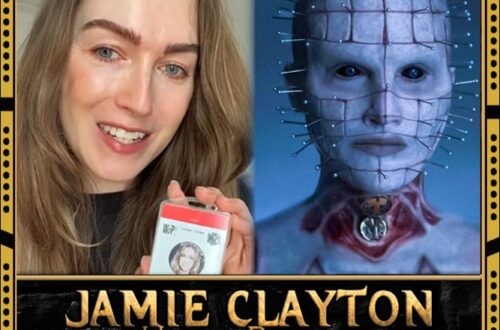
Well, I thought Jamie was great. I thought Jamie was a genuinely eerie, fabulous presence. Yeah, I like it. I mean, I’ve actually seen that one. For all I know, Hellraiser VII is the best of all of them, but given that I’ve only really seen the first four and Huluraiser, I thought it was good.
I mean, I thought it’s great that they wanted to genuinely – as opposed to just doing another, ‘Can we make a movie in 10 days to retain the rights?’ – this was genuine, and affectionate I believe, attempt to reboot and revitalize it. I liked all the make-ups. And I’m certainly not dissing the other Cenobites by singling Jamie out, but she was great. She was great. I think Doug thinks she was great, and the fact that there was this sort of love fest going on between OG Pinhead and the new 2022 Pinhead was great.
Also, I have to say, again, people are just nice. The guys that wrote the new one, I had a little bit of interaction with on social media, and they were extremely kind and extremely respectful to Grandad, you know. So I have nothing but affection and best wishes for it. I don’t know now if it looks like there is going to be a sequel. I know there was intended to be, but I don’t know.
Is it Ben and Luke who are the writers? David’s the director, and Ben and Luke are the writers. So, I mean, technically I’m sure we’re still Facebook friends, but the algorithm has not kept me up to date with what they’re up to.
Would you care for a sequel to this continuity if it ever does come to fruition?
Sure. Yeah. You mean a sequel as opposed to another brand-new take? Yeah, well, this is going to sound so fucking hypocritical, given that I wrote three sequels to Hellraiser. As a general principle, I guess I’d rather have somebody else do another brand-new take or something.
In other words, do I think it needs a sequel? Well, not necessarily. But then neither did Hellraiser, and I’m very grateful it had sequels, you know? So I certainly wouldn’t begrudge a sequel. I would love to see Jamie be Pinhead again. I don’t want to say anything that sounds disrespectful to what they did. I’m also very squeamish in my old age, by the way, so that whole… is his name Voight? That whole vivisection last sequence… my God. I don’t know if I could watch that again. What the fuck? I mean, I know we’re the people who came up with Browning slashing himself to pieces on the mattress, but we were younger then than we are now.
But kidding aside, I’m not sure, having done that to him, what that sets up for a sequel necessarily. He’s kind of a Channard figure, I guess, except that at least we drew a curtain over the transformation. You know, when Julia said, “Now you know.” We didn’t watch Ken getting blood transfusions. I was also glad how much of Christopher Young’s music they used. That was great. When the Hellbound theme swells up…
I’ve only watched 2022 once. Leviathan’s in it, right? So, you know, it was flattering to see aspects of the mythos that I was involved in being reused. I don’t know… But yeah, I thought the new take was pretty good.
If you were to sit down right now and conceptualise and write a screenplay for a new Hellraiser movie, what kind of structure do you believe it would form? Would it be a sequel to the legacy movies or something entirely new?
I mean, honestly, I don’t know, because the last time I did any kind of Hellraiser-related writing was when I wrote a short story for Paul Kane and Marie O’Regan’s book, Hellbound Hearts, which was a collection of mythology stories set in the Hellraiser universe. Even then – and I’m guessing that was around 2008, something like that – I was sort of… and none of this was conscious. It’s not like I was turning my back on the Hellraiser universe at all. Not that I wouldn’t have been happy to write Hellraiser V had our relationship with Miramax remained healthy, but I felt that the door had closed. So even when I wrote that story for Hellbound Hearts, it was very much a tangential story.
In fact… you always find the shitty reviews when you Google yourself. It’s always a mistake, because there might be good stuff there, but the first hits that come up are always unpleasant. I remember reading a review of Hellbound Hearts and suddenly being very disappointed by my story before I’d even clicked on it. The way it came up on the search engine, you only saw the first line: “The biggest disappointment in this book is…”and it was my story. I thought, “Fuck me.” In fact, once I clicked on it – because you can’t resist clicking on it, however unpleasant it is – the second line was, “Don’t get me wrong, it’s a really good story and I liked it, but…” I can’t remember whether it was a man or a woman who wrote it, but their point was that Pete Atkins had been such a big Hellraiser honcho that they wanted a real Hellraiser story, and that isn’t what this was. And that’s a completely justified complaint. I could have done without the sound byte being the thing that came up first, but it’s a very legitimate criticism.
So I honestly don’t know. My guess is that if somebody said, “Here, sit down and write a Hellraiser story,” it would probably be like that. Not out of any conscious desire to prove my distance from it, and certainly not because of any, “Oh, I don’t do that shit anymore.” It would probably be like that story. I’d probably come at it from some kind of oblique angle so that it would be vaguely Hellraiser-ish without being a straight-ahead Hellraiser story.
I’m delighted that other people do it. I wrote one story for the Hellraiser comic book back in the day, and that was an honest-to-God Hellraiser story. It had Cenobites in it and somebody making a terrible mistake. So I certainly liked doing that. But I think even by the time we were doing the comic book – and as I mentioned earlier, when Miramax wanted us to do what became Bloodline, Hellraiser IV as it was still being called then – I already had this sort of fear of: Somebody finds a box. Somebody opens a box. Somebody gets fucked up by the box.
Of course, there are still a thousand ways to tell a good story from that premise. Find a box, open the box, get fucked up by the box. Somebody can bring their talent to bear on that, and it can literally be that same single-sentence through-line, and ten different writers can give you ten different stories, some of which will be brilliant and some of which will be shit. But I guess I have a built-in reluctance now to do a “find the box, open the box, get fucked up by the box” story. So it would probably be something that no dyed-in-the-wool Hellraiser fan would enjoy at all. They’d probably say, “The biggest disappointment in this book is…”
So yeah… no disrespect intended to any of us who worked together to do that, or to anybody who’s going to work on it in the future. It’s fantastic that the franchise is still alive. I look forward to the game. But I don’t have a burning desire to think, “Oh, I’ve got a great Hellraiser story to tell.” If I woke up one morning with a great Hellraiser story to tell, I’d try to find a venue in which to tell it.
Haven’t they just revived the comic book as well? I mean, not the Marvel one, obviously, but BOOM! Studios? Well then, that would be the market. If I wake up one day thinking, “Oh my God, there’s a great Hellraiser story,” I’ll try and get it into BOOM! Comics.
Do you have a dream director in mind for who’d you love to see do a future Hellraiser project?
No. Although, again, in terms of the “one that got away” sort of thing… Stuart Gordon was in line to direct Hellraiser IV: Bloodline. I’m always a little reluctant to tell that story because it sounds like I’m saying, “Oh, you’d rather have Stuart Gordon than Kevin Yagher,” and that’s very disrespectful. Not at all. It was great to get to know Kevin, but I didn’t know Kevin as a director prior to that. Whereas Stuart Gordon was the guy who directed Re-Animator.
What happened was, I’d done probably pretty close to the draft I chose to publish as the relatively recent version of the screenplay. They were looking for directors, and Stuart had expressed an interest, so Miramax packed me off to meet with Stuart. We had two or three meetings. What actually happened in the end – I don’t know if it was money. I’m not privy to other people’s negotiations. For whatever reason, Miramax couldn’t come to terms with Stuart. Whether it was Miramax, Clive, Chris, or somebody else, I have no idea. Financial or otherwise, I don’t know. It just didn’t happen.
But there are two things to say beyond that. Literally ten years later, Stuart and I were both scheduled to do a signing at a great horror bookshop in Burbank called Dark Delicacies. Sadly, it finally closed last year after about 30 years in business. Every weekend they’d have some event on, round up the usual suspects, and we’d all sit there scribbling on posters and stuff. So I walked in. It had been ten years since we’d met. I sat down next to Stuart, wondering if there was going to be something weird. But as I sat down, we shook hands, and he smiled and said: “Hey… what the hell happened?” I said, “I don’t know. I figured you didn’t want to do it.” He said, “No… the phone just stopped ringing.” So apparently – that’s probably not literally true, that’s just how Stuart put it – the phone just stopped ringing.
You don’t leave somebody like Stuart Gordon hanging. I imagine a lawyer at Miramax called Stuart’s agents and said, “We’re going in a different direction,” or whatever they say in those circumstances. But it was just funny that, with a very affectionate smile on his face, he said, “What the hell happened?” And I said, “I don’t know.”
Stuart doesn’t know what a fucking bullet he dodged, given what happened to Kevin on the shoot. So I didn’t really have a theoretical dream director, but after those three meetings he and I got on great, and I was thrilled at the prospect of the guy who directed Re-Animator making Hellraiser.
Also, like Clive, Doug and I, he’d started out in fringe, weirdo theatre. Well, I shouldn’t say that exclusively – he may have been directing films that early as well, I don’t know – but we had quite a lot in common. I had a great time talking with him. So again, with absolutely no disrespect to Kevin, I’m sorry I never got to work more thoroughly with Stuart. That would have been great.
But in terms of a more general dream director, given my generation, it would clearly be Brian De Palma or Dario Argento because they were my guys. They’re a generation older than us, but when I was leaving my teens and getting into my twenties, those were the filmmakers who really meant something to me. Obviously, I loved all kinds of horror movies, so you could name anybody from the ’30s through to the ’60s as well. But De Palma and Argento… both of them, as we were saying earlier about horror being an operatic subgenre, they’re both fucking operatic. De Palma in his prime, Dario in his prime… I don’t know whether either of them would ever have soiled their hands with a Hellraiser movie, but that would have been great.
Thinking about the Cenobites and your other creation, The Djinn from Wishmaster, how might they view each other? Could The Djinn ever contend with or surpass Pinhead, or better yet Leviathan?
Well, I don’t know. I think it’d be like Lee Van Cleef and Clint Eastwood. We’d have a series of close-ups of Doug’s face… Andy’s face… Doug’s face… Andy’s face. They’d walk around each other… The comic version would be that they’d have this standoff where one of them says, “What’s your pleasure?” and the other one says, “What is your wish?” And they just keep fucking saying that to each other without ever answering the questions, until eventually they both get bored and think, “Fuck this.” Clearly they are different cosmologies.
The Djinn, as an imagined race, are part of an established mythology – from the religions of the East, from Zoroastrianism, and to some extent… I want to be very careful not to say anything offensive… I believe there are still jinn and ifrit in Islam. I think it was more Zoroastrianism… I’m an ignorant Westerner. So the Djinn are not a Judeo-Christian concept.
Now, we did our best with the Cenobites to very much not make them a Judeo-Christian version of Hell. There’s no flames, no Dantean circles of Hell. But it would be interesting, on a sort of metaphysical level, to postulate it as a conflict between an Eastern cosmology and a Western cosmology. I don’t think Pinhead would be comfortable being considered a representative of Judeo-Christian values. But, hell, we borrowed the term from Judeo-Christian mythology, so I don’t know.
I’d pay good money to watch it. You’ve got Leviathan… I actually think – and I said it as a joke – but I think what you’d really have is an impasse. Neither of them can do anything without your consent. Now, they might trick you. The nature of how that consent is granted might technically not be what we’d call consensual. But they do have that in common. You have to want to open the box. Desire calls. You have to make a wish. However disappointed you might be in the outcome of opening the box, and however shocked or disappointed you might be by the way your wish is granted, they’re not vampires. They’re not zombies. They’re not werewolves. They’re not slashers. Well… obviously Pinhead unbound in Hellraiser III had his brief moment of slasher glory. He was just a vindictive force on Earth.
But for the most part, they share that commonality: they can’t harm you until you’re stupid enough to allow yourself to be harmed. So I do think it’s an impasse. That’s what’s interesting about it. Obviously it wouldn’t literally be:
“What do you wish?” – “What do you want?” – “Open the box.” – “Make a wish.” – “Open the box.” – “Make a wish.”
But I think that’s the way to look at it. It’s an immovable force and an unstoppable object. I’m not going to grant either one superiority.
I will say this, though, just to wrap it up with a gag. A friend of mine, Julius Vladimir Francisco – I do not claim this, he claims it – believes the Djinn in Wishmaster is the most powerful movie monster of all time. His reasoning is a little a-textual. Because the reason he believes the Djinn is the greatest, most powerful movie monster of all time is that the Djinn kills Freddy, Jason and Candyman.
And he’s right… only in the sense that he doesn’t actually kill Freddy, Jason or Candyman. He kills characters played by Robert Englund, Kane Hodder and Tony Todd. But the way Julius likes to look at it is: “Wishmaster. Toughest motherfucker on the planet. Kills Freddy. Kills Candyman. Kills Jason.”
Doug has never seen off Robert, Kane and Tony… But Andy has. So I’ll just leave you with that thought.
Were you asked to consult for Hellraiser: Revival?
No.
Hellraiser: Revival is set twenty years after the events of Hellbound: Hellraiser II. What do you envision the game exploring?
The wonders of the Labyrinth…
I don’t know. I mean, I would guess the wonders and the terrors of the Labyrinth. From some of the clips I’ve seen, it looks very much like Hellbound – we’re inside Hell, we’re in the Labyrinth. We see Leviathan, we see the Escher-like landscapes. Also, I know it’s a game, so I’m assuming there will be a sequence of rooms in which unpleasant things happen. Depending on how well you survive the room, or the level, you’ll move on to the next room or the next level.
I should confess right now, I’m too old. I’m not a gamer. I’ve never played a video game. Well… other than Space Invaders. Other than playing Space Invaders on a console in a pub in 1983, I’ve never played a video game. Obviously, I have nieces and nephews, and indeed younger friends, who love them and grew up with them. But it’s kind of an alien world to me.
So I might be being very dismissive when I say you’ll go from room to room and level to level. I’m sure things have become much more sophisticated than that, and I know there’s theoretically a narrative arc in the game.
With the New Genesis configuration, what do you make of a new box being introduced which grants power to the wielder?
What? Wait a minute… Pyrokinesis? Yeah… it sounds like an opening for Barbie. I should be back… Oh, well.
Anything that allows imagination to roam and invention to take place, I’m in favour of. Obviously, in some ways – and I’m not suggesting for a second that the game will do this, I’m sure they’ve dealt with it properly – it does undermine the scary nature of the box. The whole point is that you think you’re going to get what you want, but the interpretation of that might be somewhat different.
So the fact that it’s a box that grants things rather than takes things… well, it’s good to have an antithesis. So, based on the information you’ve provided me, I’d say that sounds like an interesting starting point for adventures within the Labyrinth.
I didn’t want to sound like some snooty old fuck who doesn’t understand video games. “Oh, so it’s a first-person shooter with a fucking box?” I’m sure it isn’t. But it did sound a bit D&D, a bit “gain powers, roll the dice.”
So if that was actually all it was, I’d probably think, “Hmm… I’m sure that’s not the case.” Also, it’s got to allow the player… like I say, I’m not a gamer, so I’m not even really sure what the pleasures of a game are. I assume you’re not just an observer – you’re a participant. So there has to be a way for you, as the player, to function in the game, rather than just, “Walk this way, be a victim… stop playing.”
So yeah, I’m sure they’ll make that work.
What can fans look forward to seeing from you next – any exciting upcoming projects and convention appearances?
Sure. I’m doing a couple of… like I say, they only want actors at the autograph shows, but because I snuck in as an Artisanal Cenobite, I do occasionally get to join my old mates. So this November I’ll be at Days of the Dead Chicago, and in January 2027 I’ll be at Days of the Dead Atlanta.
I’m not trying to drum up sales for them, but they’re both pretty big Hellraiser reunions, to be honest. I guess technically it’s 40 years since the first Hellraiser – or will be next year. I can’t remember whether it was released in ’86 or ’87, but that’s 40 years ago. In Chicago there’s at least ten of us, and in Atlanta I think there might be even more. I know they’re trying to get Clare, but, as with you guys, they don’t necessarily have Clare yet.
I think Paula Marshall is going to do Chicago, I think Craig Sheffer, who we mentioned earlier, is going to be in Chicago. Courtland Mead, who played little Jack in Bloodline, is going to be there. Valentina’s going to be there. Obviously Doug, Simon, Nick and Barbie… yeah, let’s try keeping them away. I mean, they’re at all of them. Frank is going to be there as well. I think he’s doing Chicago, and possibly Atlanta too.
So both of those will be big Hellraiser reunions. I’m definitely in Chicago – they’ve certainly announced me as being there. I don’t appear to be on the poster, but for Atlanta they’ve got a little block of ten of us. So I’m pretty sure I’m at both of those, and it would be great to meet any Hellraiser fans. That would be fantastic.
Quickfire: Kirsty or Julia?
What? I don’t know. What am I picking here?
Kirsty. Look, Kirsty is Snow White and Julia is the Evil Queen, so…
Oh, can’t a guy have both? Come on! Here’s the problem. I feel it’s one thing if these are entirely fictional characters in prose work, where there wouldn’t be actual human beings involved – the actors, I mean. I’ll say this: I had a lovely lunch with Clare, where we met Charlton Heston one time at Pinewood. But Clare and I haven’t kept in touch, and I haven’t seen her since we shot Hellbound. Ashley, though, is still a mate. I’ve known Ashley forever. So because of the actual human people involved, I can’t not say Kirsty. So I have to go with Kirsty, because Ashley is my mate.
That wasn’t one fucking word though, was it?
Quickfire: Dr. Malahide or Dr. Channard?
Well… Malahide, of course.
Should we explain the context for people who don’t know what the question means, or shall I just say “Malahide” and let them guess?
Quickfire: Stupidest scene in all of the Hellraiser franchise?
Well, I’m not falling for that one because, as I say, I haven’t seen the later ones. So what you want me to do is pick something and say Clive did a ridiculous thing. Well, I’m not doing that, mate. Actually… you know what? I fucking well will. I’ll pick one, and I’ll pick one of mine as well to even it up.
I don’t think a healthy young heterosexual girl like Kirsty would be turned on by a guy swallowing a lit cigarette. Clive has the guy do that at the dinner table – but he sort of half-swallows a lit cigarette, and Kirsty gets all, “Ooh…” about it. I remember thinking, “Fuck off.” So I would say that’s the most ridiculous moment in the first four Hellraiser films.
Other than… I’ve got to say, I did worse. Oh God… Again, I don’t really want to say it because I don’t want to cast any shade on the actors, but I do have a twinge of regret for: “Ready for your close-up, Joey” and “that’s a wrap.” So… yeah, I’ll say that.
Quickfire: Female Cenobite or Deep Throat?
Yes, good job. They didn’t hit them then. I think yeah, it’s always a good idea to physically avoid balls of of infernal energy if one can.
Quickfire: Sadomasochists From Beyond The Grave or What A Woman Will Do For A Good Fuck?
I’ll go with What A Woman Will Do For A Good Fuck – I think that is the driving impulse of the first movie.
Quickfire: Least favourite Cenobite?
Are you really going to make me do that? I don’t know the fucking names from the later ones. Also, you know, it would be really unfair of me to pick any from the later movies because I haven’t seen them. So for all I know, whether the movie is good or not, it might be a fantastic design. It might be a great performance.
Oh… well, you know, obviously I simply have to take the bullet. I’ll just say Barbie. I’ll say me.
Quickfire: Chatterer with or without his eyes?
Aesthetically without, but I know it’s important to Nick that he could fucking see, but aesthetically without.
Quickfire: Joey or Terri?
Come on now… That’s why I’m useless at this, because I’m always thinking, “What if I make a living person unhappy…” Like they give a shit what I say, you know?
Well, obviously Joey is the heroine. The smarter one. The better person. But I only have to look back at my dating history – particularly when I was in bands – to say… Clearly, hands down, Terri would historically be the choice.
Quickfire: Which Cenobite would be the worst dinner guest?
Well, I’m tempted to say Pinhead because he is the most talkative. All long-winded… Now, whose fault is it that he is the most long-winded? It is my fault.
But if I’m trying to get on with my dinner, I don’t want him blathering on about, “Down the long decades of your pain…” It’s like, “Hang on, mate… pass the salt.” So I’m going to say Pinhead.
On the other hand… he can quote poetry. No, let’s stick with Pinhead, because it’ll make people hate me.
Hellraiser has been experiencing a real renaissance, with the 2022 reboot and the upcoming Hellraiser: Revival, introducing the franchise to a whole new generation of fans. Does it bring you joy to see the series continue to thrive, and how does it feel to know you are part of such an enduring and fascinating legacy?
Now that’s the best question. Thank you. The answer is yes, of course. I feel really lucky and really blessed, and yes, it absolutely brings me joy.
I’m delighted for all of us who were involved. Anybody who does anything that, 30, 40 – hopefully one day even 50 years later, still finds people who weren’t even born when we made these things taking an interest… it’s a lovely feeling. It’s great.
So I’m delighted that there’s been a pretty steady affection for, and interest in, the Hellraiser films. But you’re quite right, there does seem to be a little uplift at the moment – a bit of a renaissance or reinvigoration. So yeah, I think it’s fantastic. I’m touched, honoured, and all those buzzwords that people use. The things we did all those years ago… it’s a long time now. The Hellraiser movies are now old. I mean, the theatrical films, the first ones, are now older than the classic Hammer films were when we made the Hellraiser movies.
Back then, those Hammer films seemed glorious. We were all fans of them, but they also seemed so distant. You’d think, “My God, there are still people on the face of the earth who worked on those things.” In fact, there was a lady called Aida Young who had been a producer – not quite in the first great flush of Hammer, but she’d worked on several significant Hammer films.
She was brought on by New World during Hellbound to be a kind of on-the-ground representative, rather than flying somebody over from the US. Not because they didn’t trust Chris as a producer – he’d already proved himself on Hellraiser – but they wanted somebody to be their eyes and ears. I was up in the production office at Pinewood when somebody said, “Blah, blah, blah… Aida Young’s downstairs.” I said, “Aida Young? Are you fucking kidding me?” So I went pelting down to the soundstage to meet this lovely woman. I say “older”… she was probably about 61. I just completely fanboyed over her. I could sort of tell within about three minutes that she was thinking, “Oh God… another one.” I don’t think Aida was necessarily a horror fan at all.
I think she was simply a professional, highly competent woman who knew how to produce movies. So having some stupid horror nerd come running at her saying, “Late Hammer… blah, blah, blah…” I could just watch her eyes glaze over.
So let me assure any Hellraiser fans out there that – Aida was lovely – but unlike Aida, my eyes will not glaze over if you come and tell me how much you love the Hellraiser movies… or even Wishmaster. You’ll love him. My eyes won’t glaze over because, unlike Aida, I am a horror fan. I was a horror fan when I was eight years old, and I’m still a horror fan now. So it’s genuinely delightful that people still like what we did.
Thank you. And thank you for helping keep the fire alive.

—
Thank you so much for taking the time to share your memories, processes, insights and theories with us, Pete. It means a great deal to the fans and community alike, and we truly appreciate your role and contributions to the Hellraiser movies you collaborated on. Your work continues to inspire and excite Hellraiser fans around the world and may your legacy be eternal!


You May Also Like
Adam Faison | Colin
Simon Bamford | Butterball