Keith Thompson | Lead Concept Artist – Hellraiser (2022)
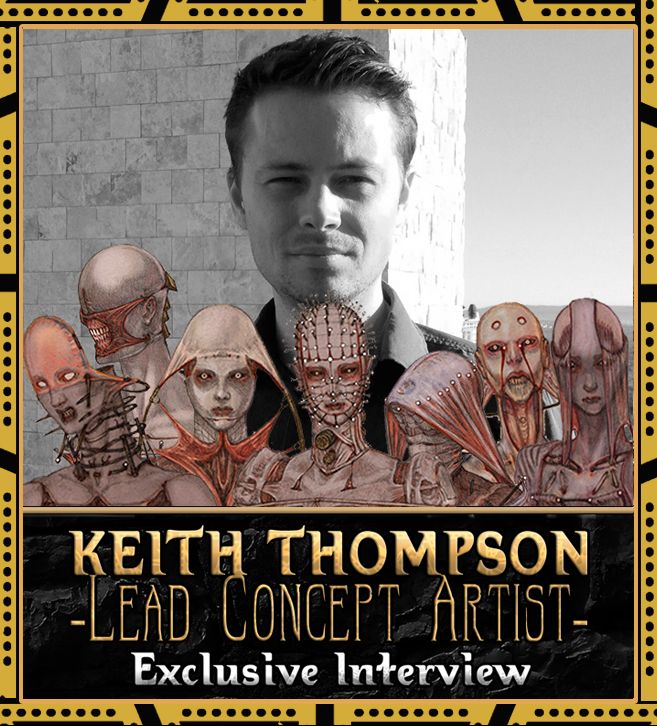
We spoke with Keith Thompson, the Lead Concept Artist on Hellraiser (2022), about reimagining the Cenobites and diving deeper into their conceptions, working with David Bruckner, honouring Clive Barker’s vision, creating the film’s striking aesthetic and more:

Thanks so much for the interest in the art, it was such an exciting opportunity to contribute to the mythos!

Can you tell us how you came on board Hellraiser (2022)? What was the path that led you into the project?
I’ve been lucky to work with director David Bruckner on a quite a few films prior (one of my favourites being The Ritual). The production knew they needed to approach the design work as seriously as possible and they cast an extensive net to find an artistic approach that could hold up to the demands they, and the audience, would have. Things developed well after the first salvo of explorations and I came back to the project and put together a small team to help execute all the new design work in the movie.
What was your initial vision when you began designing the new Cenobites for Hellraiser (2022)?
I always gravitate to a timeless approach in my work and don’t tend to follow any current trends (which do have their place in some works). While I could have probably continued a lot of the established themes and aesthetics happily there was a motivation from the production to disconnect from some of the themes that were very new and transgressive in the 1980’s but might seem overly familiar today. The Cenobites’ pursuit of sensation and desire would still be central but I explored melding that with a more medicalized aesthetic rather than underground fetish club. I felt the ecclesiastic structures really needed to be maintained and could contribute to a very interesting marriage of visual structures.
I traded a lot of the black leather for more films, skins and membranes, and swapped out the grit and grime for more sterilized surgical themes and textures. I really wanted them to still always feel like they coexist perfectly fine with the other Cenobites, and that these new appearances spoke either of a different movement or period of their existence (no different from how the people and their clothing and settings differ from the earlier movies) or possibly of a different sect or group of Cenobites pursuing their own unique and grotesque goals on the other side.
How did you work and translate designs and concepts with director David Bruckner? You are both building an excellent catalogue of collaborations together.
Even though we’ve worked together on many projects, each film always ends up with its own unique process. This one was a first for us working together on an existing IP that we were both big fans of. We wanted to ensure it was a genuine creative vision we developed for it, just like our original world building before, but also had to do absolute justice and ensure it felt like a true Hellraiser vision. It was important we gave it a vitality and didn’t fall into the trap of simply fulfilling a safe and formulaic entry in the series.
Were you a fan of Hellraiser prior to becoming the lead concept artist on the latest movie?
Yes! Saw them a bit later in life than I would have liked (university) but was always captivated by the covers in VHS rental stores and the lovingly painted resin kits I would see in comic and hobby shops.
Can you describe your typical creative process – from early sketches to final production concepts?
Lots of discussion with the director; some very long ones going long into the night. Visual design is always visual storytelling and it has to run that deep. If the conceptualization stops at “how it looks” with no impact on every other part of the movie then it will always be visually shallow. I will spend a lot of time pacing around my studio imagining approaches going down extremely elaborate paths even to the point of how something might move, sound, background elements like how it was made and its many connections within the world building. Then I’ll start sketching something out (I still work mostly traditionally standing at a large drafting table). At a very early stage the line drawing is a creation fully realized, and the rest of the work is design execution. The drawing is really such an important stage to see when and how things click.
I find if a design becomes belaboured it’s better to return to the beginning and find a new path. Eventually if the project allows I’ll follow the execution of the design down to the finest details like precise textures, movements, anatomical measurements, etc. I was able to follow the Cenobite designs through a lot of this path luckily.
What were some of the biggest artistic challenges you faced in reimagining such an iconic horror universe?
Biggest challenge was everyone’s nervousness about working with such an iconic IP and doing justice to the richness of Barker’s original creation. With some other adaptations I’ve done like Tolkien there’s a certain distance from the origin and people expect a contemporary creator’s sensibilities to be a part of an adaptation, with something like Alien the world building has an expansiveness where a new creator’s own take feels like it fits into a notch in an expansive galaxy. But Hellraiser is in a tricky spot where some of it is so fresh and clear, and other parts are still cast in deeply unexplored mystery. I really try to follow earnestness in my work which I hope makes big unique decisions feel genuine to a passionate and critical audience.
The Cenobites in this version have a distinct anatomical and exposed look, appearing entirely devoid of traditional costuming – what inspired that design direction? Did the process initially start with more classic, leather-based concepts before evolving into this interpretation?
I did some explorations with black leather (or inky black dyed skin). I felt that the medical and stark white explorations were really exciting with how different they were from the previous Cenobites but still felt unmistakably part of the whole entourage at first glance. David really loved the idea of them being truly nude in the sense that all the fabric was fashioned from their own bodies (something I attempted to manage when taking into account that I literally “stretched” to make some parts work). I really tried to mix that with the ecclesiastic garment forms. There’s also a lot of classical and neoclassical nude sculptural notes I was influenced by, particularly the iconic but eerie sculptures we’re so familiar with from antiquity that are sensuous, voluptuous and muscular but then defaced and dismembered by time. This nod is something that even literally shows up in parts of Voight’s art collection.
How did you balance staying true to Clive Barker’s original designs while creating something new for modern audiences?
The balance was always measured by the impression we’d get leaving a design for a period of time and then returning to for a fresh view. We had a hat as the audience and fan we would wear and then we had the hat of creator. We would take very serious time wearing each to double check our progress.
Did Clive Barker’s original paintings or writing influence any specific design decisions?
The bejewelled pins in the writing were a reinforcement for me pushing for the pearl capped pins. I felt like an emphasis on a beauty and elegance was supported by much of the writing and I wanted to bring a lot of that into things without losing any of the visceral intensity or extremes.
Each Cenobite is outfitted with what you have referred to as ‘Leviathan tech’ – Can you give us a juicy breakdown of what this entails for each Cenobite and the intended purposes?
I thought of the “Leviathan tech” and the puzzle boxes themselves in this movie as literal parts of Leviathan’s body. They are like relics or gifts imparted into the Cenobites’ bodies, a vile sacrament where the adherent takes a bespoke part of Leviathan’s body into their own. There’s a sinister quality to them where Leviathan may very well be directly witnessing or inducing things through the small pieces it has pushed through into our world.
As Voight seemingly has now ascended and become a Cenobite, what sort of Leviathan tech do you picture becoming part of his design?
That’s a really interesting question and it becomes distracting to me how fun it would be to explore him as a Cenobite in any new project. Especially considering how his wish made of the box underwent a significant change. His first choice still shows in his body, but his corrected true choice would introduce wholly different effects from the previous Loom. In the future maybe Voight, a bit like Frank, still does not appreciate his new gift?
Did you draw inspiration from medical illustration, sculpture, or other art forms for the bodily motifs?
Yes, one example is the patterning on the facial grid of the Hell Priest taking cues from old porcelain phrenology models. A lot of the clothing pins and clamps mix old illustrations of medical dissections with haute couture fashion design. I’m hugely influenced by pre war artwork and culture in all of my work.
Were there specific materials, textures, or symbols you wanted to emphasize to evoke both the beauty and horror in outfitting their clothing with skin?
I wanted their viscera to appear very clean and clinical (like how a surgery looks) as though a lot of the blood is kept very localized, with a lot of the exposed internals often being pink, lilac, purple, vermillion, white, ivory, etc. rather than anything appearing infected, filthy or aging (those grimy qualities would be more connected with Voight’s filthy torment). I capped the pins with pearls, in some places using them like the sartorial pins of a tailor. I kept the hooks and chains simple, but inclined them to more surgical forms in places.
What can you tell us about any Cenobites and concepts that were ultimately scrapped -Were they originally more than the seven that made it to the final movie?
There were a few more, and some of the seven went through some pretty big shifts. I’ve included some of the rougher ones that we dropped. Looking back on them there are some fun directions they took. Honestly I feel I could explore Cenobites indefinitely, there’ so many interesting directions to take.
At one stage, Mother’s design included a porthole in her abdomen for the baby to peek out of. What were the creative ideas or symbolic choices behind that concept, and how did you envision it being realized on screen? Additionally, her razored fingertips are a striking feature – was that intended as another extension of Leviathan tech?
She was one of the first “out there” attempts I took for something that felt in keeping with Hellraiser but exploring very different extreme sensations and desires. The idea was the deep longing and want some people have to conceive and carry another life inside them. In some versions the Mother actually wants her baby to experience and enjoy all the possibilities of the world and the baby has migrated up into her head and she has retreated down into the womb. At some times she would be in charge, and at other times the Cenobite would be a crying screaming baby treating others as their plaything.
Her razored finger tips score grids on her stomach and are an enhancement some of the Cenobites have incorporated into their bodies, a similar example being the sewing machine needle on the tips of Masque’s finger they use to write new names into their own flesh (or others).
Were you involved in guiding the evolution of the Cenobite designs developed by RusselFX – from the initial maquettes to the final prosthetics – to ensure they stayed true to your original vision?
Yes, I’ve collaborated with them often and they’re wonderful to work with. They appreciate that both tiny proportions and details are essential to the whole success of a design as well as the overall proportions. While timelines were tight we tried to stay in contact as much as possible while things were executed.
Looking back retrospectively, are you ultimately happy with how the Cenobite designs were translated to film, or would you change anything now, three years on?
I think there are so many lessons in this execution that could be learned from and leveraged in another exploration that might really take things to another level. I hope one day we get a chance to test them
What does Hellraiser mean to you personally as an artist?
It’s a wonderful work that exists in its own right. I got a chance to work in that world and filter it through my own visions to create what I hope was an enjoyable viewpoint. It was a very fulfilling opportunity.
Which Cenobite design was your personal favourite and which one was the most challenging to develop to a point where you felt fully satisfied with it?
I really liked the elegance and classical human forms Gasp mixed with extremely elaborate viscera ornamentation. I think that mix of beautiful bare human sections lying beside mad flesh decoration is something I’d want to push even more.
Masque was always a weird one that changed form completely, more than I usually like in exploration. In the end the final idea for him was basically a completely new shot that suddenly clicked. He was a good lesson not to get bogged down on tweaking details trying to find something that should be intuited. Though the most challenging was probably the Hell Priest for somewhat obvious reasons. The original is such an iconic and cemented design. The intent was really trying to make something that might stand beside the original since trying to improve or top it in any manner would be foolish.
The seven Cenobites are in a boxing-ring, who comes out on top and why?
Haha, oh no I can never do that, my mind could never get past all the contextual questions as to why on earth that would be happening. Still, it makes me wonder what it would be like to see more of the Cenobites on the other side in the Leviathan dimension, how they interact with each other and what other denizens lie there with Leviathan. Some kind of Cenobite intrigue and bizarre rituals would be so exciting to depict (and I admit I did imagine some very eerie pilgrimages and other strange rituals they might indulge in). If I ever got to tackle that I think I would first rewatch the Skeksis in The Dark Crystal and then maybe Conclave!
Have you yourself seen all eleven Hellraiser movies – If not, which ones have you not seen or actively avoided?
Yes I always do a deep dive on any project I work on (though I’d seen most of them long before, and also have enjoyed much of Barker’s work). When I was younger I had so much fun with Hellraiser 2, but now it’s impossible not to appreciate just how good the first one is. I may have played the NES game… but I can’t officially say if I have or not.
Hellraiser has been experiencing a real renaissance, with the 2022 reboot and the upcoming Hellraiser: Revival, introducing the franchise to a whole new generation of fans. Does it bring you joy to see the series continue to thrive, and how does it feel to know you are now part of such an enduring and fascinating legacy?
Always wonderful to find myself involved in something a young me once pored over in wonder. I think there’s a lot more fascinating things to explore in the Hellraiser world I hope it expands with an originality and vitality it deserves.
What do you know of a sequel for Hellraiser (2022)? It seems there are still going discussions on getting it the greenlight.
I’d always be the last to hear. It’d be nice to hear at the last minute that I’m getting a chance to revisit the world again.
Will you return for a potential sequel? If so, can you detail what you’d hope to see and explore in the future?
I certainly would, and always love a chance to work on anything with the team again. I had a mad idea I pitched for this one that I’d try again but I suppose I should keep it under wraps if it has a chance of getting picked up.
Are you a gamer yourself? If not, will you experience Hellraiser: Revival hands-on yourself?
Yes, I love games and work a great deal in games as well. I’ll certainly check it out if I get a chance.
What are your thoughts on the upcoming video game along with your opinions on the artistic direction?
I like to see how the game or movie holds up once it’s out rather than weighing in on trailers, it can be very tricky appraising them at that point. I have experienced many of my own projects seeming a little unrecognizable once it’s shown through the marketing machine.
Which platform will you be playing the game on – Playstation, PC or Xbox?
No major preference, I keep up with all the platforms so I don’t miss out on any of the actual games that are gems (I also have an extensive retro collection I’m always adding to).
What can fans look forward to seeing from you next – any exciting upcoming projects?
Some new film projects might be coming out soon, I’m not entirely sure, and I hope I’ll start on new projects later this year if I can make that work. However one that’s been my baby for over half a decade now has recently started showing itself: the game Soulframe (some connection with my other big game undertaking Warframe). There’s a lot of me in that and I hope a lot more to come as it develops.
Thank you so much for taking the time to share your concepts, processes and insights with us, Keith. It means a great deal to the fans and community alike, and we truly appreciate your role in bringing this new ‘Gash’ to life and reinventing them in such a striking and unique way. Your work continues to inspire and excite Hellraiser fans around the world and may your legacy be eternal!
Thanks so much to the audience, your passion for this is something I share wholeheartedly and I’ve been lucky to add some bricks to what we’re all making.
Keith’s website: https://www.keiththompsonart.com/