Kenneth Cranham | Dr. Channard
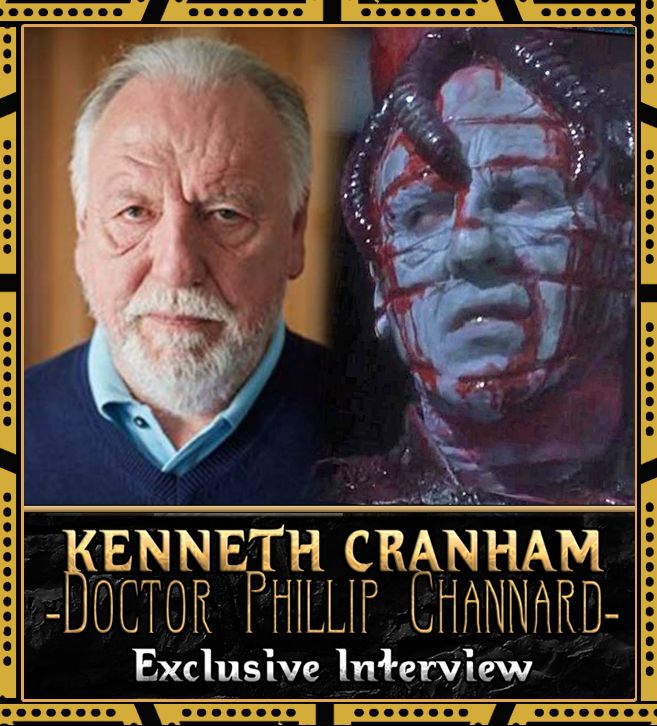
In this candid and often darkly humorous interview, Kenneth Cranham reflects on his unforgettable turn as Dr. Philip Channard in Hellbound: Hellraiser II – a role that remains one of the most disturbing and celebrated in the franchise. From childhood fascinations with forbidden horror to the physical and psychological demands of becoming a Cenobite, Cranham offers a vivid behind-the-scenes insight to the chaos, creativity, and real-life danger of bringing Dr. Philip Channard to life.
—

What first attracted you to the role of Dr. Philip Channard in Hellbound: Hellraiser II?

There was a great tradition in my childhood for horror comics, and they were American and they were sort of like, you hid them under the pillow because they were so frightening. You know how children really enjoy being frightened. And that became a desperate desire to see X films when you were too young to see them, and you used to do things like hold your collar up and wear a heavy coat and stuff like that. And put your voice low when you went to the box office trying to get in to see these films. And there was one that I saw, which was a big screen version of the story called The Fly, where a man gets caught up in a sort of transforming mechanism and becomes part fly and it was a big cinemascope film. And I managed to get in to see that. And it was quite alarming visually so I realised I was engineering my life so I could get to see X films, which is absurd.
I was in the Air training corps, because when you did that, you went out to Air Force camps and you were able to take part in the life that the airmen had. And they had cinemas and they showed X films. And you could get to see X films. One of them is called The Screaming Skull. I can’t remember much else about it. But it was one of those sorts of areas where you’re forbidden. And it becomes incredibly attractive. It was psycho that really changed the nature of horror films completely. Because then you’ve got a master filmmaker making a very clever, cleverly told story.
What happened was, I was offered the part of King John in Shakespeare at Stratford. And I had a look at that play, and it’s not a terribly good play or a very good part, but at the same time, Hellraiser came along and I went to see the first Hellraiser on my own. I couldn’t find anyone to go see it with me. And I thought Hellraiser 1 was extraordinary. It had a sort of off-the-peg sort of thrown-together sort of reality to it. And I thought Claire Higgins was extraordinary. In truth, there was a pair of Art Nouveau French curtains were on the market. And I thought if I do Hellraiser II, we can get those curtains and pay the tax bill. If I do King John, that doesn’t sort anything out at all!
And Gary Oldman, who is younger than me, his girlfriend at the time had said “I’m going to take you to show you what you’re going to look like when you’re older.” And she took him to see my one man show., and bless him, he came to see it for a second time! It really meant a lot to him – But he wanted to do a horror film, and this ended up influencing me and I thought, well, I can get ahead of him on this one – I can do Hellraiser and of course, he eventually did a vampire film, Bram Stoker’s Dracula wasn’t it.
What were your thoughts on Hellraiser II at the time, whilst filming?
So what happened while I was doing Hellraiser II was that I did get gaps when I was injured, I didn’t know if I was going to recover because there’s an element to the film industry when they take risks with human beings that you really shouldn’t.
And at one point I went and saw a Degas retrospective in Paris, which was one of the most extraordinary things I’ve ever seen. It was on one stage; there were three huge galleries of women in domestic undress. And I just thought I’m in heaven. It’s just wonderful. And it’s exactly my vision of the world, I thought. And so I got to do extraordinary things while I was doing it and what happened is what one of the things that attracted me to the first Hellraiser that I saw was how much Clare Higgins reminded me of Fiona, my wife. Then Fiona and I, we were cast together in Shine on Harvey Moon. She played my son’s head mistress, and we had a love affair in Harvey Moon. That’s where we met one another. Well, it was lovely because both her and Clare Higgins had striking Irish beauty. And they had that sort of thing of the eyes, the Hurricane Higgins about them, you know, they had a bit of that. And so I’ve got one of my own now, you see. And we’ve been together 40 years. But she is terrific. And we have a little girl, we have a daughter who’s now in her 30s who’s acting, but it’s in a different world than the one that we were in because we were I was known as the archetypal royal court actor, which is exactly what I wanted to be. I didn’t want to be anything else. And I was in 20 odd shows there and so it took me somewhere else. A lot of people said, well, of all the things you’ve done, Hellraiser is the thing that impresses me most because it’s simply because it surprised them that I should do such a thing because it is it is rather sort of poetic in some dreadful way.
They didn’t let me go to the canteen, which was horrible – When you were the monster, you weren’t allowed to go to there because you put everybody off their food. Because what they used to do was cover you with monster economy sized tubes of KY jelly, which was dripping off every bit of you. It was most unpleasant visually. So they’d lock you up like a prisoner and bring your food to you. And it was always not hot anymore by the time you got it and I had to stay in my dressing room and not go to the canteen. The days when I was in my civvies clothes, as Dr. Channard was such a joy that I could sort of walk about and go to the pub and things like that. Covered in ‘herpes’ – I think it’s the herpes because what they used to use was nurses’ textbooks of skin conditions. Oh, you’d look at the ones that made you wince and they were the ones that they copied and then they paint ‘herpes’ all over you. Weeping herpes was a speciality on Dr. Channard when he was the Cenobite. And subsequently, I mean, once I was when I was in the studio, I exited by the wrong door. And suddenly I was in a car park. And there were people sitting in the car park. And they looked at me with such alarm and their dog started to really bark at me.
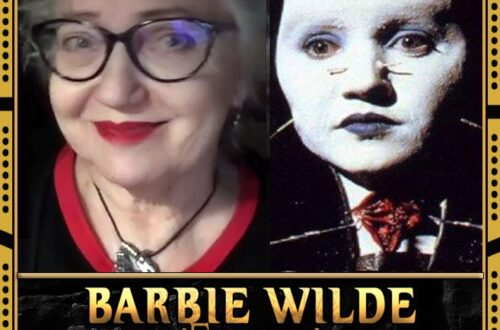
And what they did to me once was put me through all that makeup and didn’t film me… That was really hard. There’s a photo of me and Barbie Wilde in makeup, but I have to say that Barbie lives off that photo.
it’s such a sort of striking photo, isn’t it? No, but you could put the egg stamp on her forehead in that picture, couldn’t you? -Laughs-
Did you expect it to become such a cult classic when you were making it?
it’s quite nice that it’s had such a long and celebrated life in its way. It’s nice to have something like this in your past and not to have to do it again.
Have you seen the film in its entirety? What about your thoughts now, retrospectively?
I mean, I’ve seen it quite a few times, but I couldn’t imagine seeing it more than I’ve seen it.
Recently I went with my wife Fiona, we went to Cologne together to one of those things where you sit behind a desk and you sign photos at this convention and there’s people wondering about in horror sort of outfits, there’s that one with the screaming face, a lot of them wondering about doing that. And you find out that the person who’s helping you with the signing isn’t being paid. They for some reason they want to do it, you know, something. Yeah, but they’re volunteers. And which sort of surprises me, but they’d like sort of being in a large, enclosed space, wondering about in horror outfits. And so, you know, that’s up to them really, isn’t it? But the last one I did was in Manchester, it was a combination of all in wrestling and horror.
Channard undergoes one of the most dramatic transformations in the franchise. How did you approach playing both his human-self and his Cenobite form?
Well, what you do is when they make you look like that, you think, what performance am I going to do which tunes in with appearance? And I mean, visually, I don’t think there’s ever been anything else quite like it. Because of being injured, there are far too many shots with my feet dangling into shot and stuff like that. They sort of simplified it a lot visually. And maybe if they hadn’t injured me, it might have been more extraordinary visually, although it is quite extraordinary visually, isn’t it?
Did you view Channard as a true villain, or as someone whose curiosity simply went too far?
Well, I think I think it’s sort of one of those things. With my dramatic recitation, I won first prize at the Eltham Hill, How about that? And it was run by these old ladies, and they gave me a cup for it. But they misspelled my name on the cup. I didn’t collect it. I thought, oh, stop it. You know, you can’t have a cup with your name misspelled – They called me ‘Kenneth Graham’!
So that was my first experience of sort of transfiguration, really, with Dr. Faustus. So that idea of selling your soul to the devil has been around quite a long time, really, hasn’t it?
Channard is a terrible awful, but he himself is rather well spoken. Very articulate, quite charismatic in the sinister way. That’s the nearest I got to James Bond!
Channard conducted extensive research into the box and its surrounding mythology and seemed confident that giving the razor to the patient would allow him to push his understanding further. His decision to bring the patient into his own home suggests absolute confidence in his conclusions. If his research had proven to be nothing more than myth, how do you think Channard would have rationalized – or dealt with – having a dead patient on a mattress with nothing to show for it?
Browning was probably not the first victim for Channard in his pursuit for answers, we already know that he murdered Tiffany’s mother in order to gain access to Tiffany as a means of opening the Lament Configuration which establishes that he had crossed moral and legal boundaries long before Browning had entered the picture. But the time of Hellbound: Hellraiser II, Channard’s obsession with the Lament Configuration has completely overridden any remaining ethical restraint. To him, human life has become a disposable currency in the pursuit of forbidden knowledge.
Any sacrifice, intentional or collateral would’ve been justified in his mind as a necessary step towards transcendence. If Channard’s research had amounted to nothing more than superstition and myths, he likely would’ve rationalised Browning’s death as an unfortunate but acceptable clinical failure, rather than a crime. As the owner and authority of his own hospital, he possessed both the institutional power and practical resources to make patients ‘disappear’. Records could be altered, deaths reclassified and bodies disposed of without scrutiny – particularly when the victims were already marginalised or institutionalised, like Browning.
In this sense, the house mattress is less an anomaly and more an extension of Channard’s belief that he operates above consequence. Channard is also highly persuasive and manipulative, a trait we see clearly when he convinces the police to release the mattress, an object that should unquestionably be treated as homicide evidence. His calm authority, his medical credentials and intellectual arrogance allow him to control narratives and neutralise suspicion. Had the Box failed to yield results, he would have likely leaned on those same traits to explain away Browning’s death as a tragic psychological episode, or an unavoidable risk in experimental treatment.
Ultimately, Channard’s greatest safeguard is not his research, but his certainty. His absolute belief in the Lament Configuration, and in his own destiny means that even failure would not have shaken him, it would simply have justified the next experiment, the next subject, the next body. Reinforcing the idea that Browning was never meant to be an end result, only a stepping stone.
Do you suspect that the patient ‘Browning’ was actually his first attempt to engage with the supernatural, or merely the first to give him access to the further region?
I believe Browning was not his first attempt but was the first attempt of Channard engaging directly with its physical incarnation. Specifically, through Julia and the mattress. Prior to this, his engagement with the occult appears to have been largely academic, an observational researching. Collecting testimony and studying cases. Through Kirsty, he had learned a crucial truth – that Frank had returned, not through ritual, but physical space. The knowledge reframed the supernatural for Channard – transforming it from an abstract mythology into reproducible process.
The mattress saturated with Julia’s remains, represented something unprecedented, a tangible gateway, where Hell had already breached the material world. By bringing Browning into contact with it, Channard was no longer testing belief – he was testing mechanism. Browning was a controlled variable, a subject whose suffering could potentially trigger a known phenomenon. In that sense, Browning was not an exploratory experiment, but a calculated escalation, based on prior evidence. This distinction suggests that Channard had already engaged with the supernatural indirectly, through research, manipulation and secondary witnesses – but had never positioned himself so close to its threshold.
Browning was the first patient used to determine whether access to the further regions could be deliberately engineered, rather than stumbled upon. When this failed, Channard did not abandon his pursuit, instead he adjusted his method, turning to Tiffany, whose unique aptitude with the Box offered more a more precise key. Seen this way, Browning’s role is tragically utilitarian – he’s not the beginning of Channard’s obsession, but the moment when obsession becomes experimentation. Where belief gives way to practice and Hell shifts from theory to destination.
Could the moment where he kisses Julia be read as evidence of his lingering humanity, a flash of earthly desire or perhaps it was manipulation for Julia to grant him what he believed he wanted?
I said about Julia’s character, I can compare her to Lady Macbeth, and he didn’t know who Lady Macbeth was. I was very surprised because we all know what Lady Macbeth means, don’t we? Very much. He’s really part of our sort of doll’s house of characters that we can sort of pay a bit of attention to, isn’t she? But Tony Randel didn’t know who she was. That’s surprising. Americans don’t study Shakespeare.
Channard’s lust for knowledge ultimately becomes his undoing. Why do you think he relents when he’s finally presented with Leviathan?
I think Leviathan gives him flashbacks of his childhood and Channard regrets having sort of having this obsession or this lust for knowledge. And then he wants to leave. But Julie is like, nope, you’re here to stay. I haven’t seen it for a long, long time, I don’t remember fully what happens when he is presented with the Leviathan… But I think he’s quite an intriguing character altogether.
When Channard steps out in his Cenobite form and remarks, “And to think, I hesitated,” do you feel there was still a trace of his human-self still present – similar to Dr. Jekyll & Hyde – briefly aware of the cost of what he’s chosen and wondering if he should have turned back?
When Channard steps out of the Cenobite creation chamber, Channard is fully aware of who he is and what he has become, and like characters who experience fragmentation or moral duality. Channard’s transformation is not a loss of self, but a clarification of it. This is precisely what the gift bestowed by Leviathan is, not madness, not confusion – it is absolute purpose.
By the time he steps forward, Channard’s human identity has not been erased, but merely perfected into something colder, more efficient and entirely aligned with the will of Leviathan. His remark ‘and to think I hesitated’ isn’t an expression of regret, nor a fleeting return of conscience, instead it is a moment of retrospective disdain for weakness. The hesitation he refers to, belongs to an earlier version of himself. When fear briefly intruded his mind in the Labyrinth, not because of moral doubt, but because of uncertainty.
Crucially, Channard does not wonder whether he should have turned back, he marvels that he ever even considered it. The line reads as self-reproach, not self-reflection. Any fear he felt was rooted in the unknown. Noting the cost of his ambition, now the transformation is complete, that fear has been rendered obsolete.
The Cenobite Channard stands as proof that the price was not only acceptable but was necessary. Unlike other Cenobites who suffering or conflicted origins, Channard embraces his new role entirely. He does not mourn his humanity, because in his mind, it was never something to be preserved. His ascension confirms what the film steadily implies, Channard was always moving towards this outcome. The transformation did not corrupt him; it rewarded him as Leviathan’s new right hand. He’s not a cautionary figure, but a fulfilled one.
How much creative input did you have in shaping Channard’s personality and his descent into obsession? Were you given much of a backstory for Channard? Or have you created your own, for who he was and how he came to be?
No, I didn’t. I think the lines were nearly all lines that hadn’t been written for me. And so, when you look like that, an awfully long time to sit and look at yourself being made to look like that to decide how you’re going to say the lines. He slaughters all the Cenobites, doesn’t he? He kills them all. So that has its own satisfactions.
If Channard had survived or continued to evolve, how do you imagine his Cenobite form might have developed further?
I’ve got no idea what more they could do with him really, and visually at all. I think that was taken to the extremes, don’t you?
With the new Hellraiser: Revival video game being set 20 years after the events of the film, do you think it’s possible for Channard to be resurrected and explored further? Is he really dead and done?
He probably is dead, yes.
Would you entertain returning to the role of Channard if the opportunity presented itself, both in film and video-game formats? Have you had any correspondence with the development team?
I haven’t heard anything from anybody. I suppose so, rather, if there was money involved. Of course, absolutely. -Laughs-
Why do you think Channard remains such a memorable, scary disturbing character decades later? He is often revered as one of the favourite characters in the franchise entirety.
Well, you know, and subsequent people who’ve been in Hellraiser films that I’ve met at conventions are so thrilled to meet Dr. Channard. They think that he’s a big one for them!
Looking back, what does the role of Channard mean to you in the context of your career?
Well, it’s completely unique. There’s nothing I don’t think, there’s nothing else like it.
Where do you personally rank Hellbound: Hellraiser II among the projects you’ve worked on?
Well, it’s completely isolated, it’s completely on its own.
At the table of villains you’ve portrayed, do you class Dr. Phillip Channard as the most sinister of all? Even considering characters like Jimmy Price (Layer Cake), Wilhelm Keitel (Valkyrie) and even King Henry (Maleficent)?
Channard is the worst of them all because I mean, he actually uses people’s lives and their blood to live off, doesn’t he? He’s an awful creature. He’s a terrible awful. He’d be at home in Trump’s America.
How do you feel about modern audiences discovering Hellraiser for the first time today?
People have such sophisticated screens in their own homes; you know and so I think that Hellraiser too will exist very well with all of that.
No, I’m just very pleased that my love and relationship with horror from when I was young, allowed me to be in one that had such a prosperous and long life!
The flying-rig people were like a cross between builders and circus people, not the most sensitive creatures!
Do you see? I mean, I think they created a film that only certain sorts of people would like to watch. -Laughs-
Have you seen all eleven of Hellraiser films?
I’ve only seen Hellraiser 1 or 2. I haven’t seen any of the subsequent ones, but I imagine they’re quite diluted. I don’t know.
They kept changing the script a lot during filming ad-hoc, especially when you were trying to memorise your lines, didn’t they?
Oh yes, but honestly you wouldn’t believe what a mess we were in, because they actually managed to injure me quite badly, which in turn meant a complete reorganisation of the shooting schedule because the film visually isn’t what it was meant to be.
There’s so many shots of my sort of feet dangling in the top of the screen and stuff like that. That wasn’t meant to be, I think it might have been a bit more gracious and balletic, if you can imagine such a thing.
That was just a simplification of their imaginations because they had injured me. Do you see what I mean? Nearly broke my neck!
Do you have a favourite Cenobite design from the series, aside from Channard?
I mean, what I liked was the creature of Julia – Claire Higgins – I think she had the actress Deborah Joel play the skinless version as well. Are you imagining her, this was a big moment for her in her career. The director, the 19-year-old who hadn’t heard of Lady Macbeth, said to me, he wanted me to kiss her and he said, “I want to see tongues.” I said, “Look, she’s got flu. You’re not going to see tongues.”
What’s been your favourite or most memorable fan encounter related to Hellraiser?
I think working with Claire Higgins, who is one of a rare special breed of actresses and to get to work with her. And that was one of the things that was very attractive about doing that film. And she’s terrific.
The fan encounter with all of the little Cenobites in Northern Germany coming and having a meal with us. I thought that was very touching and I realised that the Cenobites were very much part of the population of that town. All in costume, all dressed to the nines, It’s wonderful.
What do you attribute to the endurance of Hellraiser and the world Clive Barker has created within it?
The endurance of Hellraiser lies in its seriousness of intent. It doesn’t treat horror as disposable shock but is something rooted in character, obsession and consequence. The film respects its audience, trusts them with ambiguity and commits fully to the ideas rather than explaining or stifling them. For an actor, that kind of material endures because it’s grounded in performance and psychology, not trends. Making the world feel real, unsettling and worth returning to decades later.
In terms of Hellbound: Hellraiser II, the first Hellraiser film was almost like a backyard film; but with the sequel they had a studio – with all the things a studio can produce, like distance and perspective. A real sort of ability to create distance and scale. So, it’s a very epic film.
My theory was with the timing of it, ten years later I was in America, and it was still the star pick in the video shop, so my theory is that people were starting to get wall television screens, so the density of image with Hellbound was very popular domestically. It was almost accidental; I think the success of Hellraiser II was because it coincided with people getting those big screens in their homes. So suddenly the details could really be seen.
Did you ever get the opportunity to meet with Clive Barker?
Sadly no, what happened is, at that point, Clive’s task at that time was mainly a producer and only occasionally there. I was doing 6–7-hour makeups so I barely and rarely met anyone. I’d always suspected that Hellraiser wasn’t quite going the way Clive wanted or imagined. I thought he was an unusual element in horror films, I feel he was quite surprising.
Are you still in touch with any of your fellow castmates?
I put together a one-man show called The Solider which was all poetry and prose about Kipling and J. B. Priestley to present day – and four Cenobites were in the audience. We sort of vaguely keep in touch, if one of them is doing something then the others will show up. Clare is a unique performer, and we’ve bumped into each other at conventions in the past. Hopefully that will happen again in the future, I mean, if Claire’s short of money; she does them.
Do you own one of those NECA Dr. Channard action figures?
I was quite astonished when I was filming a version of The Sinking Of A Ship in South Africa, there was a model shop there that had three shelves stacked with the NECA Dr. Channard figurines, the ones with the herpes attached to his head, – that’s irresistible to people that collect models – very appealing to model collectors. I was being asked to sign a little plaque on the front of the base that the model was on – It was always a tiny little thing, but I had to try and write Dr. Channard in it. It was really difficult.
I’ve actually given one of them to each of my daughters, with a note saying something like ‘love from Dad’ on them.
The merchandise company Trick or Treat studios is releasing a Dr Channard Halloween mask this year, how does it feel to have your character immortalised this way?
Channard’s will now be ten to a penny! I think my grandson would like one of those. My wife doesn’t like any of the Channard merchandise funnily enough!
Well, you know, the Channard face is unique, isn’t it? I mean, with the wiring and the colour. That’ll be well represented and no one will have to suffer to look like that. That’s rather a good place for it!
Thank you so much for taking the time to share your memories and insights with us, Ken. It means a great deal to the fans and community alike, and we truly appreciate your role in bringing such an iconic character to life. Your work continues to inspire and excite Hellraiser fans around the world and may your legacy be eternal!
There’s a list of quotations that you’ve sent for Dr. Channard – I realised I’ve only been using 2 or 3 of them for over 35 years!
*Ken had consulted the producer of the Leviathan documentary, Gary Smart, for some of the more involved questions.