Screenwriters | Hellraiser (2022)
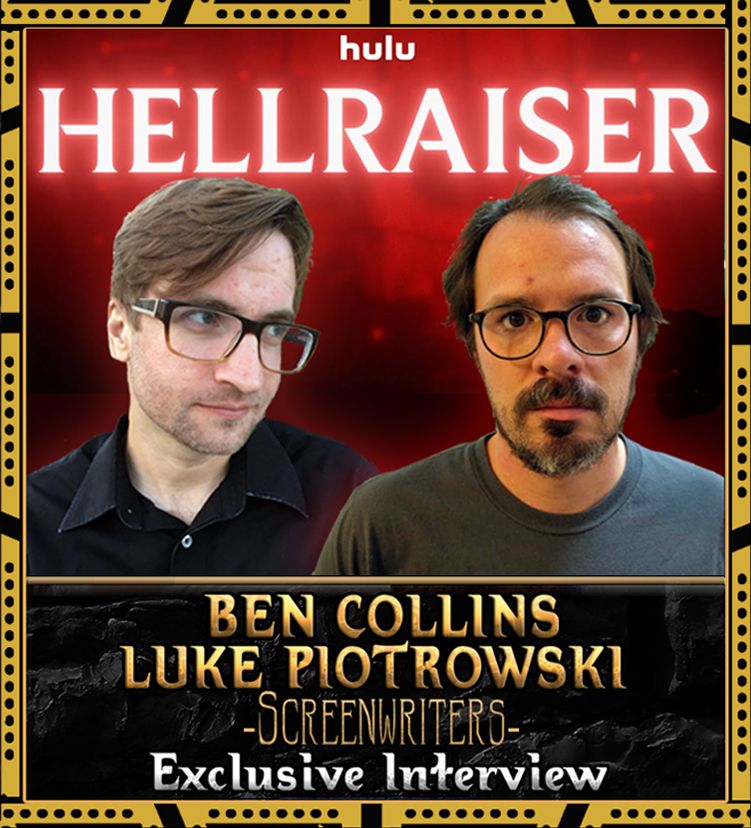
Ben Collins and Luke Piotrowski are the screenwriting duo behind some of modern horror’s most haunting stories. From the chilling Super Dark Times to the eerie The Night House, their work blends emotional depth with visceral terror. In 2022, they teamed up with director David Bruckner to reimagine Clive Barker’s Hellraiser for Hulu – bringing fresh blood and bold ideas to the iconic franchise.
Read on for their mammoth 56-question interview for Hellraiser (2022).
—
“Instead of chains immediately coming out, the blade pops out. The game has begun. And the Cenobites encourage you to finish it to claim your prize. Same mechanic, just delayed. Arrogant assholes like Voight think the rules don’t apply to them. He attempts to get other people to take the hit for him so he can reap the rewards. But the house always wins in the end.”
 |  |
| Ben Collins | Luke Piotrowski |

How did you both first get involved with the Hellraiser project, and what excited you most about taking it on?
Back when we were fairly unestablished screenwriters, our agent and manager got us a call with the people at Miramax who had the rights at the time. As children of the 80s, we were thrilled to have the chance to play with some of the most sacred franchise toys. We crafted a pitch. It was NOT what they were looking for. But, for years, Hellraiser sort of felt like the one that got away. And our individual passions for the franchise became a special point of connection between us. It was the one we both loved and desperately wanted to do. Somehow, someway.
Cut to many years later, we were making The Night House with David Goyer’s Phantom Four when we heard the news that they were working on the title with Spyglass. We shamelessly went right to our friend Keith Levine, creative producer at Phantom Four. “So… what’s up with Hellraiser?”
There was a bit more to it than that. We had to have creative discussions with them and craft some documents before being brought in to pitch to Spyglass. But as far as landing a gig in Hollywood goes, it was one of the most seamless.
I think what excited us most was probably what excites everyone here on this discord. Hellraiser is horror but it’s also something more. It has some of the most extreme violence in the genre, but also a sense of gothic poetry. A sense of the theatrical. And a mythology that is dense and evocative. Some of the most striking and elegant production design too. Of all the horror franchises, Hellraiser is the most literary. That’s something I respond to.
I have a very distinct childhood memory of seeing the VHS cover of the original Hellraiser film in a video store and being both terrified and hypnotically entranced by it. I was probably 5 years old and certainly unable to read yet. But the image of Pinhead was seared into my brain and took on a mysterious mythical quality in my childhood. I didn’t see the film until I was about 10 years old and found it playing on a local broadcast station one night. Even then I think I only saw maybe half of it. Mostly I remember seeing Frank’s regeneration sequence and having to turn it off when my parents got home so I didn’t even get to see Pinhead. Years later when I was a freshman at art school my roommate in the dorms had a DVD copy and it was the first movie we watched together on the first night we spent away from our parents.
It wasn’t until 2010 or 2011 when Luke and I were first contacted by executives at Dimension Films as part of a cattle-call for screenwriters they could hire to reboot the various franchises they controlled at the time. Luke and I were both immediately interested in Hellraiser and started daydreaming about how we might be able to play in that world in a way that could bother honor what we loved about it, but also bring it to a new audience with a level of prestige that had been lost in the franchise over time.
Of course we didn’t get the job at that time. And for years Hellraiser was the one that got away. Over the years different companies would claim to have the rights and we would meet about it. But it wasn’t until 2019 that Keith Levine from Phantom Four reached out directly to us about potentially getting involved in writing the movie that became Hellraiser 2022.
So it was a really long path but I think for me personally part of what continued to drive my interest was the desire to access that feeling of awe that I had as a child looking at the cover for the first time.
When approaching a beloved horror franchise, what were your first discussions about tone and direction?
We had a long-running joke right from the start that any reboot of Hellraiser needed three things: sex, death and puzzles. If you take any one of them away, it isn’t Hellraiser anymore. Just puzzles and death? That’s Saw. Just sex and death? That’s most horror movies. Just sex and puzzles? That’s close… but not quite.
Personally, I think tone is incredibly important when it comes to making additions to any franchise. It’s so important to dump out the box of components and see what something really is at its heart. What makes it work.
That’s doubly important with Hellraiser. Barker’s work is so much about tone. Not just what’s happening but the way that it’s presented. The grotesque and the sensual are serviced in equal measure whether on screen or on the page.
At one point, a different set of producers actually got hold of the rights and approached us. But they only cared about the title, not the tone. They wanted something with hot teens, a slasher sort of thing. And we ultimately just said “no thank you.”
To us, Hellraiser couldn’t be a slick slasher. It’s not a “hell yeah” movie. It’s not even a heavy metal movie. It’s gothic elegance laced with putrescence. A beautiful, dangerous nightmare.
I think we always like to ask ourselves “what are the most essential parts that make this thing what it is?” So the discussion starts with understanding what pieces we’re working with, and understanding the history of the franchise and what’s been done before. In a case like Hellraiser it’s fun to watch all of the old movies and kind of take stock of what works and what doesn’t, or in some cases what could have worked, all of which can point you in the direction of what hasn’t been done yet.
So the process becomes negotiating that feeling of being true to what it is but also introducing new things it can be.
Did you revisit Clive Barker’s original novella The Hellbound Heart during development, and if so, how did it influence your writing?
Many times. Hellbound Heart, In the Flesh, Damnation Game, Scarlet Gospels. Even the old Hellraiser comics! As soon as it started to become real, I began steeping myself in Barker again. I wanted more than anything to evoke those vibes. To be in that headspace.
There were many elements from the novella we tried to incorporate into the movie, particularly when it came to the Cenobites. A lot of them fell away during the road to production, unfortunately. But I want it on the record that we fought hard to keep the jars of piss Frank planned to use to anoint himself! We also had the sound of wings and birds that the book describes when the Cenobites appear but it became one element too many and we landed on just the bells.
I’ve read Hellbound Heart a few times over the years, as well as listened to multiple audio versions, (included a wonderful, abridged version read by Clive himself on YouTube) so it was very much on my mind throughout. Luke and I talked about it extensively and felt the book’s descriptions of the Cenobites gave us a lot of latitude in terms of how to imagine them in a new version.
Was Clive Barker involved in your writing process, and if so, what was the most valuable feedback he gave you?
Unfortunately, we never got to meet or talk to Clive himself. I know he was in contact with director David Brucker quite a bit, though. That’s my one big regret, that we never got the chance to collaborate with him. Even if only a little. I do know he specifically wanted to address Riley’s faith or lack thereof, which I thought was interesting and led to some discussion and some different dialogue.
You’ve mentioned that your version of Hellraiser was inspired in part by earlier pitches and ideas, and that some work you did for ‘The Night House’ grew out of discarded Hellraiser material. Are you able to detail what the original Hellraiser pitch looked like?
The short version is we wanted to do a very elegant, very hallucinatory version of The Hellbound Heart. Very Black Swan. What fascinated us about the original story and film was that Julia is in many ways the real protagonist. Kirsty is sort of the damsel in distress and the climax rests on her shoulders but most of the really juicy, emotional stuff and a great deal of the conflict falls on Julia. That initial pitch basically merged the two characters into one. The task we gave ourselves was to craft a more tragic, sympathetic version of Julia.
In our take, she was a woman who was still reeling from the sudden death/disappearance of her husband. While investigating what happened to him, she discovered that she didn’t know him quite as well as she thought she did. He had a secret side, a secret life. Secret desires that he pursued via the occult. In short, she thought her husband was a Larry. After his death, she discovered he was a Frank.
It was the puzzle box and the Cenobites who claimed him, of course. She solves the box and uses it to bargain with the Cenobites to bring him back. They agree… but what they return is not the husband she remembers. Very much like Frank in the original film, her husband comes back a tattered and bloody husk, tortured beyond recognition. Like any deal with the devil, it gave her what she wanted but it led to her damnation. In order to restore him, she had to start going out, stalking men, bringing them back to kill and feed him. It was very much a story about a woman mad with grief, trying to numb herself with violent and meaningless sex. And also a story about following a loved one down a dark path. Trying to fill a hole in your soul. Sort of a Lars Von Trier movie in a way.
The plan was for her to ultimately renege and try to break the deal, incurring the wrath of the Cenobites. But it was all very dark and elevated and not really anything financiers would be willing to make! I still think it could be incredible, though.
We ended up taking the ‘grieving widow makes a dark discovery about her husband’ conceit and using it as the engine of Night House. The earlier drafts of that one were also much more sexually charged.
How did those earlier ideas evolve and inform the final version of Hellraiser (2022)?
Ultimately, we weren’t able to take too many concepts from that initial pitch into the 2022 film. When we came on board, David Goyer already had a rough treatment. It was only a few pages long but it outlined an engine that was totally different from ours. That was the foundation we built 2022 on.
The one thing that carried over from our earliest conversations was the notion that maybe the puzzle box could offer rewards other than incredibly brutal torture. The pain/pleasure line is, of course, interesting. But it’s so extreme that it can be hard to craft a narrative around. We knew we wanted to be able to motivate people to risk using the box for other reasons. To allow for protagonists that weren’t all like Frank while still keeping those elements alive and well.
Were there any concepts from those earlier drafts that you almost kept but ultimately removed and why?
Nothing from that early pitch necessarily. The only thing I can think of was my selfish desire to see dozens of chains hanging down from the sky, lost in storm clouds overhead. A surreal image that appeared in early discussions and early drafts but was just too hard to pull off, I think.
How did you balance honouring the franchise’s mythology and established canon whilst creating something fresh for modern audiences?
We felt a great responsibility with the mythology. Our hands were tied somewhat by having a treatment already in place. But I think we got to do most of what we wanted to do in terms of adding to the canon.
We had some discussions about trying to approach it in such a way that we didn’t flat out contradict any of the existing mythology so as to perhaps allow it to exist within the extant canon. Ultimately, we had to diverge, though. From a design standpoint, it just ended up being too unique. And the new rules regarding the configurations made it clear that this had to be its own, fresh continuity.
I think for me part of why I wanted to work in the Hellraiser franchise was precisely because the canon mythology is fairly convoluted as a result of there never being a consistent authorial voice dictating the decisions between the films. For as much as I love some of the sequels (Hellraiser III is arguably my favorite of the franchise up until Pinhead shows up at the club) they seem to have each been made in service of themselves as opposed to much of an overriding mythological consistency. This is not anyone’s fault of course, the movie industry was very different when Clive made the original film.
But for our purposes the inconsistent mythology provided the opportunity to rebuild a version that incorporated aspects of many of the individual films, as well as original novella and some of the other extended universe stuff. More than anything we wanted a version of the Hellraiser mythology that both worked in our film, but could also be carried forward in subsequent films, whether by us or anyone else. I think we were successful on the first part and time will tell about the second part.
The Hellraiser mythos is extensive, with many movies, books, and comics. When you were approaching this reboot, what core elements did you feel were essential to retain, and which parts did you feel needed updating or reimagining for modern audiences?
Obviously, we had to have the box. Had to have a Pinhead. Had to have the chains. Ben and I knew we wanted to pull in some Hellbound elements too. We wanted the labyrinth, we wanted Leviathan.
I think what’s essential is that concept of “angels to some, demons to others.” The Cenobites aren’t monsters or maniacs or killers. They really are trying to share their gospel, to offer you gifts. It’s not their fault if you don’t appreciate those gifts. Pain is beautiful to them. Divine.
I also think it’s essential that Pinhead be able to communicate. Early on, there was sort of an edict to keep Pinhead more like the Night King from Game of Thrones. A silent, stoic figure. But what I love so much about Barker’s work is the point of view of the “monsters.” The original Candyman is so effective because that character is so seductive. “I am the whisper in the back of the classroom… be my victim.” I felt it was essential that Pinhead be seductive and allowed to try and sell their worldview. To give voice to an ideal.
I think for me the most crucial distinction that Cenobites have over other horror movie “villains” is that they make decisions based on their own interests and desires. They speak and make statements about their opinions, and they can lie and break their own because they enjoy doing that. So any version that dumbs them down or makes them beholden to too “rules” can only diminish their power.
The idea of adding different functions to the box itself was something Luke and I discussed way back in 2012 because it seemed to us that the Cenobites would probably enjoy having multiple ways to trick, manipulate and torture people. So even though it was a “new idea” it still felt in-kind with the behavior of the Cenobites as consistently demonstrated in the lore.
The main thing I love about Hellraiser III is that the first half is just about these two women becoming friends while trying to solve a mystery together. So I think that aspect definitely inflected some of the first half of our movie.
Leviathan is my favorite thing in Hellbound, and I guess the architecture stuff is my favorite aspect of Hellraiser IV. As Luke said, a lot of pieces came with Goyer’s treatment, but it helped that all of us seemed to overlap enough on which things felt were worth pulling from.
Were there any debates about how much lore to include versus leaving things with a level of ambiguity?
A little bit. None of us wanted to turn the movie into a lore dump. And the mystique of the Cenobites is what gives them power. We didn’t want it to feel like reading a Wikipedia entry. What lore is present should exist to give Riley clear goals and stakes.
When you make something like this in a long-established franchise you are always playing a juggling game between what the old fans already know vs what new audiences need to know in order to become fans themselves. So every decision has to kind of pass muster on both sides.
But in general, I think ambiguity is underrated. Ideally an audience is so excited by the story you tell them that they want to know more.
Were there any bold ideas or moments you had to scale back?
Well, my boldest ideas that had to be scaled back had to do with the origins of the Cenobites. There’s an interesting arc in the franchise. The “hell” of Hellbound Heart is figurative. There is no mention of God or the devil or even a traditional “hell.”
The Cenobites are interdimensional explorers, in search of sensation. Over time, that changes, you see elements of Judeo-Christian mythology sneaking in. The labyrinth in Hellbound seems to be a literal hell where people are being punished. Pinhead is in a church, tormenting a priest and mocking the act of communion in Hell on Earth. By Scarlet Gospels, Pinhead is literally battling Lucifer!
I liked the romance of all that, the Paradise Lost quality. And I had some ideas I wanted to explore on that front that resonated with the themes of Riley’s journey. I’m not sure how much detail I want to go into. Still holding out hope for a chance to explore it elsewhere… But I wanted to really sink my teeth into “angels to some, demons to others” and what that means Biblically.
Ultimately, Brucker was more attracted to the simplicity of the interdimensional travellers concept and any references to Judeo-Christian mythology were stripped away.
Addiction, desire, and compulsion have always been central to Hellraiser. How did you both decide on which themes to emphasise in this version?
As I mentioned earlier, the very first treatment Goyer shared with us and the very first draft of the script leaned more heavily on grief. Riley had lost her brother before the film started and was spiralling as a result.
BDSM is a massive part of the DNA of the franchise but the extremity of it can be hard to relate to for a broad audience. That was the balancing act. How to emphasize a desire for pain/punishment without necessarily relying on a protagonist whose wants were so far removed from the majority of the audience?
But we wanted our heroes involved in those themes. They couldn’t be mere innocent victims, we wanted true Clive Barker style characters who carry a lot of darkness inside of them.
What drew you to explore addiction as part of Riley’s arc, and how did you balance that with the supernatural/horror elements?
Once we started to pull away from the grief aspects (thank God, because it was already very played out even several years ago), it was a no-brainer to dive headlong into Riley’s addiction and self-destructive behavior.
It got a little lost in the translation to screen but, to me, Riley is a dominant personality that wants to be submissive. Like many addicts, she hates herself and the things she does but everyone in her life is so accommodating they are unable to offer the punishment she craves. She has no tools to absolve herself of her sins, so she just ends up hating and punishing herself more.
She’d like nothing more than for her brother to call her on her bullshit. When he kicks her out of the house at last, it’s a sort of relief. Fucking finally! She even has to direct him, instruct him in how to yell at her. “Say it like you mean it. GET OUT! Like that.” She’s taking the cat o’ nine tails out of his hand and showing him how to swing it.
The supernatural elements were meant, of course, to evoke all these feelings and desires. Some of us don’t think we deserve anything but pain. It’s what we secretly crave.
How did you approach writing Riley’s journey as a protagonist, and what made her the right lens for this story?
I know I’m attracted to flawed characters. Both as a viewer and a writer. Hollywood has a tendency, especially in horror movies, to resort to a sort of pure, virginal archetype as the protagonist, one with some moral high ground or incorruptibility that we’re meant to value. That’s just not Barker. And it’s not that interesting. Or even all that relatable.
We wanted someone who is, at least in part, responsible for what’s happening, who is driving the narrative. Not just reacting to an outside antagonistic force but being forced to face and be accountable for their own actions. The antagonism within. Under the skin.
That’s what it is to be an addict. You don’t just hurt yourself. You hurt everyone around you. That is her journey. And her final choice. To Lament the destruction she has wrought.
To me it was important that the Riley character demonstrate an interest and an ability to “solve puzzles” and that she be the type of person who could become self-destructively consumed by that pursuit. This trait preceded the choice to focus on literal addiction as well and even in the more grief-centered versions of the story that Luke has referenced we played with backstory about her being some kind of savant math genius who had failed out of MIT after her brother’s tragic death. By the time we got to the addiction centered version we realized we didn’t need as much explicit backstory as long as we were demonstrating her puzzle-solving abilities with the plot about her trying to figure out the disappearance of her brother.
Ultimately I think the characterization all worked hand in hand with Odessa’s performance and that what we resulted in is a complicated character that struggles with her flaws while also demonstrating a kind of intellectual strength that helps her at least survive to the end of the movie, if not actually succeed in her goal of saving her brother.
Up until the casting process I had been imagining the character as being more in her late 20s. When it became clear that Odessa was the right actor for the role we had to question whether the character as written still made sense for someone in their early 20s, as Odessa clearly was. For me this felt like a crucial change in a way because of the addiction plot that had become the focus of development. Riley being 21 or 22 made the character more hopeful somehow, that maybe despite all of the mistakes she’s made that she can actually learn from them and change the way she chooses to live her life. This of course is in stark contrast to someone like Voight whose addictions to power, wealth, sensation lead to him literally becoming the most horrific version of himself.
So in answer to why she was the right lens for the story I guess it’s because maybe Riley is someone who could have ended up the way Voight did but because of this experience she’s had we want to believe she’ll take a different path.
Riley has been a somewhat divisive final girl – do you think she holds up against the iconic horror final girls of the past?
I wish I had been clearer on the page and during production regarding all the sentiments above. I don’t think we landed every nuance onscreen. But I would rather have taken the swing and landed with a divisive character than played it safe and regurgitated the usual ingenue. I think Riley is a strong and interesting character. I just wish we got to see a little more vulnerability from her throughout. I have great empathy for the fuck ups and the assholes of the world. In fiction, I just need to see that they know they’re a fuck up and an asshole and be pained by it. A little goes a long way.
I’m too biased to give an objective answer because I love RIley. I get that she’s difficult for some people but I like to think it helps the movie more than hurts it. I hope the fans embrace her more as time goes on, but it’s okay if she’s always an acquired taste.
How do you see her after the events of the movie? Is there a form of canon that you have for where she goes and what she does in the future?
I think it’s just like Pinhead says: she has to live. To carry that weight. For me, conceptually, every “reward” the box offers is a type of pain. It might be physical, intellectual, or emotional. But it’s always pain.
Once you’ve opened the box, you are fucked and there is no winning. Riley may not be having her skin ripped off within the Leviathan… but she is still going to suffer in a way that is just as interesting to the Cenobites.
It’s a dull, slow, pain. The ache of her guilt. The burden of her knowledge. That was always the ending we wanted to drive toward. The Lament Configuration is such an evocative name. I wanted to embrace that.
So, what’s next for her? The same as any addict, I imagine. She has to own the damage she caused. Try to be better. But life is hard. Life is pain. She’s on the same road as the rest of us.
I hope Riley is staying sober and going to meetings and therapy. I suspect she may also be active on conspiracy subreddits as well as being among the many people demanding the release of “The Voight Files”. I hope she finds some kind of creative outlet or something that can give her some peace.
The figure of Pinhead is iconic, with Doug Bradley’s performance being very influential. What was your approach to Pinhead in this movie – in personality, in philosophy, and in visuals? How did you think about the legacy and audience expectations while still making something new?
We wrote the very first drafts just imagining Doug. Even going so far as to put all of Pinhead’s lines in bold. Hearing his voice in our heads. But we all knew it probably wasn’t going to be Doug. And the worst thing would have been having someone do a Doug impression. So we knew it had to be different. As everyone has noted, The Hellbound Heart describes the character quite differently.
The quickest way to differentiate it was to go female. There’s a precedent for that in the comics, after all (Kirsty herself!). Subsequent drafts went more in that direction. But that didn’t really change how we approached the character. The lines and personality all pretty much stayed the same. It was more of a casting issue than a conceptual issue.
I will say our Pinhead did ultimately become less booming and stern and more sensual and seductive. But that was true from the start. I mentioned Candyman earlier and in some ways, I found myself channelling him as much, if not more, than Pinhead when it came time to articulating the Cenobites worldview. There’s some Gary Oldman Dracula in there too.
What I wanted was for Pinhead’s threats to Riley to almost operate as temptations. I wanted to get some Barkerian turns of phrase in the dialogue. In hindsight, the scenes between Riley and Pinhead could have been hornier. But then, that’s true of most scenes!
There are always going to be people that reject the new. Pinhead is tied to Doug more than other iconic horror characters for sure. But I think Barker’s concepts transcend a single performance. It’s too juicy to limit to one interpretation.
We all love Doug. I think the best way to uphold the legacy of the character he originated is to not try to recreate it, to instead go back to the book and work from there to make sure we aren’t stepping on his toes or stealing from his toolbox.
And I think Jamie is so alluring and curious and calculating and threatening. She crushed it. I wish her take had made a bigger impact culturally.
I mentioned the story earlier about seeing the VHS box as a kid, and I’m not exaggerating when I say that it was so unlike anything my brain had ever imagined that it was closer to something otherworldly or even god-like than just being some guy in makeup. That said, as I got older and began to understand how movies are made, the limited resources Clive et al had on some of these films became more apparent. So when you imagine making a new Hellraiser movie, the first desire is to be making it with a cinematic style and approach that is a level above what the franchise had ever done. So it was understood by us that our approach to Pinhead had to be new and fresh in a way that was requisite to the intended scale of production. But I think the desire to elevate Pinhead to being as otherworldly and godlike was there from the beginning. In as much as it was possible I hoped the audience would see our Pinhead the same way I saw Doug’s version. But to do so means making it necessarily different.
How did you handle the expectations of fans who are deeply attached to Doug Bradley’s portrayal of Pinhead?
Personally, I feel the Cenobites are more malleable than other characters who had incredible originators. They feel more like characters from theater. Archetypes, ripe to be re-examined. We’ve had a hundred Hamlets. Half a dozen Jokers. Pinhead, to me, can be as rich and varied.
And we will always have Doug’s Pinhead. I grew up with Jack Nicholson’s Joker, then fell in love with Heath Ledger’s. Then there were a few others…. That’s why I am so glad that Jamie’s Pinhead looks so different from a design perspective. To maintain a sort of purity to Doug’s version and not feel at all like we’re trying to compete.
David Bruckner went on record to advise that Doug Bradley had been reached out to for a cameo. Do you know if this would’ve been as his Pinhead, as himself, or playing another character?
I believe he was going to be the man who hands the box off to Menaker in the opening. But he politely declined. When it comes to Hellraiser, he’s Pinhead, not anybody else. And I respect that!
Does Jamie Clayton’s exceptional ‘Hell Priest’ exist in the Labyrinth alongside Doug Bradley’s? Are they from the same order, or perhaps another sect?
Ultimately, we ended up compartmentalizing a bit and deciding to cordon 2022 off as its own, separate continuity. So while actively writing, we were mostly looking at this as a different universe with a different set of Cenobites.
I always imagine the Cenobites (in both continuities) as being pretty timeless. They’ve been around for ages and will be around for ages. So I don’t see them updating or altering their appearances and modus operandi much.
There could be different sects I suppose. It’s not that difficult to imagine ways in which the two Pinheads could interact. But it wasn’t something we were building in or accounting for as we worked on the film if that makes sense.
Luke is giving the accurate answer as to how we conceived the movie. But considering the vast possibilities the mythology suggests, it doesn’t necessarily preclude the idea of parallel realities, alternate dimensions etc. Or there’s also the possibility that Pinhead and the Cenobites appear in a way that is catered specifically to the person who summoned them. I believe it was our friend, filmmaker Elric Kane who suggested to me many years ago that in the 1987 movie the Cenobites wear black leather because that’s what Frank expected when he summoned them, because that would have been transgressive at the time. Of course, in the modern world BDSM gear is just as much fashion as it is indicative of a lifestyle, so naturally their appearance changes and becomes transgressive to the time and the person interacting with them.
None of these ideas were intended in the script and are not supported by the movie, but it’s fun to think about.
If you were to write a story where both co-exist, how would you illustrate their dynamics and their relationship to one another, if any?
I hesitate to dive too deeply here. If I was going to attempt to do something like that, the pressure to do it right would be enormous. And I don’t want to think too hard and fall in love with an idea I’d never be able to actually see to fruition!
BUT… if I had to give an off-the-cuff response… I can think of a few interesting avenues. As I mentioned earlier, as far as dynamics go, Doug is more forceful and commanding, Jamie more manipulative and seductive. Doug’s Pinhead is more of an old school, fire and brimstone preacher. He’s spreading the gospel whether you like it or not. His threats are overt and his authority absolute. I get the sense that Jamie’s Pinhead, however, is earnestly trying to convince Nora, for example, that what she’s doing to her is a good thing. A holy thing.
In short, Doug’s Pinhead will do things to do. Jamie’s Pinhead would rather encourage you to do things to yourself… and watch. Physical dominance vs. emotional or mental dominance.
Those dynamics could make for an interesting crossover. If I was tasked with crafting a narrative where they interact, I can see merging the continuities by telling a story about Doug’s Pinhead tiring of existence at last… and seeking out a successor.
I’m not entirely convinced Jamie’s Pinhead was ever human but I bet there’s a juicy journey in saying that she was. And watching her open the box and fall under the sway and tutelage of Doug. Master and apprentice.
Of course, the final victory for Doug’s Pinhead would be to create a monster powerful enough to overthrow him and give him the oblivion he seeks. Sort of a passing of the torch narrative. Themes of corruption and obsession. Falling in love (not necessarily romantic love) with the things that destroy us or the things we long to destroy
I’m genuinely enjoying reading Luke’s answers here because these are questions no one has asked us before! Imagining the two of them together is very fun, I could see them being a very effective and terrifying pair, but I agree that it’s more likely that Jamie is the apprentice who became the master. I kind of assume Cenobites have an indeterminately long lifespan, like turtles or sharks. Being apex predators they are unlikely to get killed or die, but it doesn’t mean they can’t die, or that maybe after an eternity they wouldn’t want to die. It’s all pretty interesting to consider, but I agree with Luke that the mystery of the Cenobites is what makes them feel more powerful and terrifying and when you introduce too many “rules” that dictate their existence it chips away at the perception.
Yeah, there are so many ways to go. I could also see them entering into a Book of Job style wager. Lucifer betting God that he could break Job’s faith. That’s all very Hellraiser to me. Very sadistic. It would be fun to see both Hell Priests choose a target (perhaps the descendants of their respective final girls?) and see who could get their victim to break first… and join the Order of the Gash…
With multiple Cenobites introduced (including new designs), what was your brief or goal for how they should look, act, and interact with human characters? Which existing Cenobites influenced your design or behaviour choices, and which ones you wanted to depart from?
That was an endlessly evolving conversation. Ben and I knew we wanted Pinhead, the Female Cenobite and the Chatter. The original crew. I guess it’s clear that someone is missing from the mix. Poor Butterball didn’t make the cut. Something about his design was hard to translate and update. The sunglasses feel too Matrix and there are uncomfortable undertones that his weight is somehow part of what’s being portrayed as grotesque. It was just kind of an unspoken thing that he would have a harder time getting an update. Though at one point I did playfully suggest that Voight’s Cenobite should evoke Butterball to make the whole reboot a defacto Butterball origin story!
Maybe if there’s ever a sequel we can find a way to include him.
Bruckner definitely wanted to steer away from the leather-bar look of the original characters. What was transgressive in the mid 1980s is much more commonplace now. So we sought a design that still evoked extreme body modification and club culture but also played with religious iconography. Robes and cassocks. And of course, nudity. Flayed flesh as their clothing.
Were there other Cenobites designed or scripted that didn’t make it into the final edit of the movie?
The star Cenobites were always Pinhead/The Priest, the Gasp (who was initially called The Gape but got softened/censored… in grand Deep Throat/Cunt Throat tradition), the Chatterer, the Weeper and the Asphyx.
The Asphyx is the one I’m most proud of as that was wholly my idea. I wanted to include different kinks and types of “torture” in the designs. The breath-play/latex play Cenobite felt like such untapped territory. It was actually based on a dream I had years ago where I visited a theme park that had an attraction called “Clive Barker’s The Fitting” which was just a really claustrophobic and upsetting vacuum sealing experience!
The biggest thing we lost (and it still bums me out) was a sequence Bruckner came up with where the Weeper split open completely and became a sort of quadrupedal creature. There’s production art of it out there somewhere I believe… or there might be on the upcoming German Blu-ray release. It was incredibly cool but had to be cut for budgetary reasons.
Fans have questions about the “Mother Cenobite” who sadly only had two seconds of screentime. Can you detail some of her role in the script and what she got to do in some of the deleted scenes?
The Mother was Bruckner’s Star Wars cantina Cenobite! She was created expressly to have only two seconds of screen time. He wanted a blink and you’ll miss it WTF moment. “Wait, did I just see a pregnant Cenobite!”
All I can say is that the Mother was Bruckner’s idea and all I ever wrote or saw in the script was more or less what you see in the film. That said, I wasn’t on set when they filmed her stuff and it’s very likely they had some different takes and perhaps more business with her and the Masque closing in on or menacing Colin and Trevor.
There was some fun design variations for the character, though. Including one with a porthole in her stomach for the baby to peek out of, sort of Death Stranding style. It was wild.
How closely did you collaborate with the effects and design teams to ensure the Cenobites and set pieces matched your script?
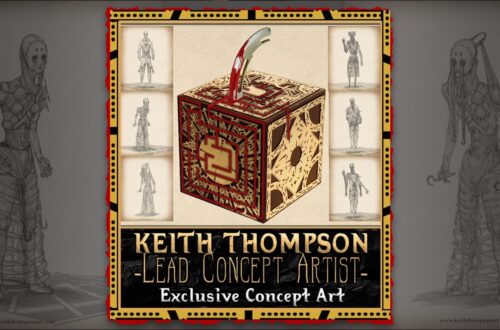
That was mostly a Bruckner thing but he kept us appraised of all the developments and shared all the art with us along the way. We are big fans of creature designer Keith Thompson and knew we were in good hands once he was brought on. A shout out to Patrick Horvath too who helped design a lot of the gags involving the real world merging with the labyrinth (the van and the bathroom). He’s a filmmaker and now an Eisner winning comic book creator (check out Beneath the Trees Where Nobody Sees… there’s a lot to like for Hellraiser fans!). He helped craft the “negative space man” in Night House and did some storyboard work here.
Patrick Horvath, Keith Thompson, Josh Russell, and Sierra Russell all worked on The Night House as well, so we’ve had the benefit of being socially friendly with all of them over the years and as soon we got the job writing this movie we hoped to have Bruckner come on eventually and assumed he would bring as many of the gang as he could. Even though their work largely takes place after the writing has happened, I think knowing that we likely would have a great design/fx team gave us more confidence in the writing process that our work was just as much about inspiring them as it was telling them exactly how every character should be.
Who are your favourite Cenobites from the previous Hellraiser movies, and what about from the new ‘Gash’?
It’s a tough question. Ultimately I have to go with Chatterer 1 from the original movie. I don’t like him with the eyes! It’s just such a cool and frightening design. With a built in, iconic sound effect. As a monster kid, he was always the favorite. (Though I did have a little crush on Barbie as the Female Cenobite in Hellbound! I won’t lie.)
As for the new ones… like I said, I’m proud of the Asphyx. If nothing else I have made a true contribution to canon by creating an original Cenobite!
BUT! I have to say my favorite of the 2022 Cenobites is The Gasp. I think her design is just exquisite. A great mix of old and new. I love the vaginal throat wound. I love the headpiece that calls to mind a nun’s wimple and also seems to pay homage to Angelique from Bloodline. And Selina Lo who played the Gasp is just the nicest person ever. She spent so much time with us during our set visit, running around Serbia all night.
It’s a cop out but I have to say Pinhead is my favorite in all versions. The first time we saw Jamie in full costume on set I was so overwhelmed with emotions that I cried. I could remember being five years old and being so scared of this character but also unable to look away. Here I was, thirty something years later and we were face to face, happy to meet each other for the first time. It was one of the most powerful moments of my life.
But I’ve always loved the different iterations and I’m proud of our Gash and Chatterer. Asphyx has a special place in my heart. I remember when Luke first had the idea for it and I was thrilled to see it come to life. I’d love to find a little Asphyx to have on my desk at some point.
Are you able to provide us with some blurbs or footnotes for the six new introduced Cenobites? Their roles in the ‘Gash’ or potentially their backstories?
We never had too much spelled out. Personally, I’ve always loved the mystery of the Cenobites. The more we know about them, the less scary and powerful they become in our imaginations. That said, there might be stories there. It would be fun to mine them in sequels or comics.
I will say there was a sort of hierarchy we were working with, though. It’s pretty clear that The Gasp is Pinhead’s second. Even in the original films, she tends to have as much to say as he does. I imagine she wields a great deal of power and if anything were to happen to Pinhead, she would be the next Hell Priest.
Chatterer was someone we saw more as “the muscle.” He seems less eloquent and intelligent than the others.
The Asphyx seems to be on a similar tier. The ones that can’t communicate. They both seem more subservient to me.
The Weeper feels more of the same tier as The Gasp. I could almost see her as The Gasp’s apprentice. I don’t know what the backstory is but I bet that would be a really tragic and poetic one to explore.
And then, the Masque was a pretty late addition. Personally, I associate him with the Lore Configuration. He has sacred writings etched into his flesh. Visually, his mind is elsewhere. Absent, in fact. His flesh is a mask with the vast expanse of the entire world behind it.
Come to think of it… I wonder if there is a Cenobite representative of each configuration? Masque is Lore. Gasp is Laudarant. Asphyx – Liminal. Weeper – Lament. The Mother – Lazarus and Pinhead -Leviathan? Hmm…
Damn Luke is inventing some pretty mythology on the fly here! I don’t think we ever fully discussed the idea of each Cenobite representing or being associated with one side or configuration, but I think it’s pretty cool. We should probably ask Bruckner if he was thinking anything like that.
All seven of the 2022 Cenobites are in a boxing ring – who’s coming out on top as the champion?
Pinhead can call the chains… But the Gasp can call the wires (I love the wires). Hmm. Chatter has reach but he’s kinda slow. I think I have to put my money on Pinhead. She’s not taking anybody’s shit. She’s in charge for a reason.
Agree with Luke’s logic, but the wild card here is the Voight Cenobite at the end. I’m not really clear on what he can do but I would be very curious to see him get in the mix.
The puzzle box has always been a character in and of itself. What was your process for expanding and reinterpreting its role, essentially introducing the six new configurations?
This was something Ben and I actually discussed for our initial pitch. Could the box perhaps offer more “rewards”? Albeit ones just as fucked up and frightening as Franks’s prize. We discussed the idea that maybe solving the box could let you 1: go with the Cenobites, 2: send someone else to the Cenobites or 3: reclaim someone that they had taken (or who had died).
Once we got Goyer’s treatment with the “six sides, six sacrifices” concept, it made sense to up the prizes to 6. Get that perfect 666. I took inspiration from the different recognizable “moves” we see the box make in the original movies. The sunburst arrangement. The piece that pops out that sort of looks like a sprite from Space Invaders. I actually made some terrible sketches early on of what the different configurations could look like.
Like Geoff Johns building off the established Green Lantern lore to build an entire emotional spectrum, there was something enticing about the idea of crafting a bigger lore for the box. What if “The Lament Configuration” was just one of many configurations?
The movie makes some bold choices with the puzzle box configurations. Can you walk us through your reasoning and the ideas behind now needing the box to “cut” the solver and no longer needing the ‘desire’ element from the original conception?
The box is, and always has been, a trap of sorts. Frank thought he desired the “pleasures” it contained… but he didn’t. It was more than he bargained for. It is, at its core, a deal with the devil conceit. The devil promises something you want. And provides it… but not in the way you wanted.
Goyer’s treatment had an element of having to offer multiple sacrifices to the box. We liked the idea that the box was ultimately harder to “solve.” In the original films, it seems pretty simple. You rub the circle and out pop the chains.
The treatment suggested the possibility of a puzzle box that could take the entire movie to open completely. That was appealing to us.
We wanted the box to feel dangerous any time someone held it. It has the ability to essentially “bite” you. Any time a character held the damn thing, we wanted the audience to sit up. Ideally, I wanted to make it so that if you were to see a prop or replica of the box in real life… part of you wouldn’t want to touch it.
In the end, it’s not all that different from the hooks in the original films. In the first movie, Frank has to obtain the box and solve it to get his prize (the extreme sensations). It opens and hooks and chains emerge.
In our version, if you want one of the prizes (including but not limited to extreme sensations) you have to obtain the box and solve it. Instead of chains immediately coming out, the blade pops out. The game has begun. And the Cenobites encourage you to finish it to claim your prize. Same mechanic, just delayed.
Arrogant assholes like Voight think the rules don’t apply to them. He attempts to get other people to take the hit for him so he can reap the rewards. But the house always wins in the end.
The Lore and Laudarant Configurations seem to have gone without much explanation, besides your own interpretations. Can you give us an official answer to what these could offer the solver?
We had to leave something for a potential sequel! I can’t give an official answer. Nothing’s canon until it’s canon. On screen or in an official novel, comic, etc.
But as the guy that came up with them… Lore is knowledge, Laudarant is love. Similar to Liminal, I suspect Lore would give you what you desired… in horrific abundance. What was that old Upright Citizens Brigade sketch? The bucket of truth? Imagine having all of the knowledge of the cosmos beamed into your mind. A Lovecraftian sort of glimpse of the other side, the scope of eternity. It would mentally obliterate you. I suspect it would be something along those lines.
As for Laudarant… same rules apply. What does way too much love look like? I’ll leave that to everyone’s imagination but whatever it is, it isn’t pretty.
If you both personally had to pick, which configuration would you choose from the six and why?
Well, I’ve already admitted that in my opinion they’re all paths to pain. Riley says it herself, nothing good will come of picking anything. She tries to opt out but opting out just means picking Lament. In some ways that seems safest. Lament is the devil you know. Just living with all of our guilt and weaknesses and dying of old age.
But fuck it, I’m feeling cheeky. I want to find out what Laudarant is. Could be hot!
Thinking about it right now, I guess I would be curious to pick Lore. I am someone who likes solving mysteries and understanding things through research. Although I suspect that the “knowledge” I would gain would probably drive me insane really fast, among other horrible things that would probably happen. So maybe I would choose Laudarant and hope that some aspect of it is fun at least. I agree with Luke though that these would be prime to explore in another story.
What did your collaboration process look like together? Do you split duties, or is it more of a constant back-and-forth?
Lots of phone calls, lots of shared google docs and lots of swapping pages back and forth. Never sitting in the same room and working, really.
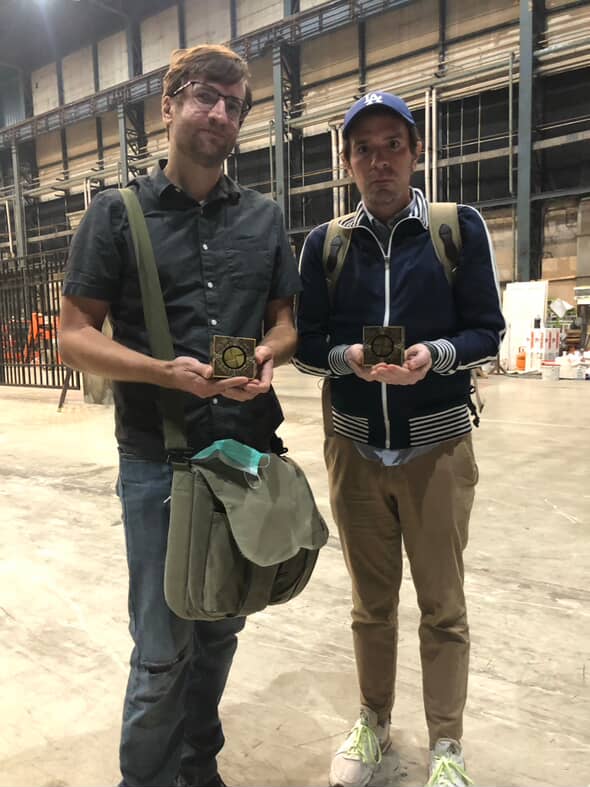
Luke and I have always written in separate rooms but this one was unique and extreme because most of the development occurred during Covid, so almost no one involved with the project was in the same room until we were on set in Serbia.
Once we had Bruckner on board we spent a lot of the development process on endless Zoom meetings with David Bruckner and Keith Levine, going over every scene and beat and questioning the logic. Considering how complex the mythology was we had to do a lot of trial and error to get scenes working in a way that would satisfy everyone on the team. So in a way the writing process was ongoing for the three years it took to develop and make the movie.
What was the most difficult scene to write, perhaps both emotionally and structurally?
Structurally, it was definitely all the big reveals at the end. Both Voight and Trevor had big exposition dumps to do at the last minute and that sort of thing is always a pain in the ass. And not terribly rewarding to write.
Emotionally, it was very fun to write all the Pinhead dialogue for Nora’s big death scene… but the further along we got, the more bad I felt for killing her!
What was the hardest scene to write (or re-write) – perhaps one that changed dramatically from what you first imagined to what ended up on screen?
Ah, the scene with Menaker in the hospital with Riley was written so many damn times. Menaker was a man in the early drafts which gave it a very different flavor. That was another big exposition scene that kept being written and rewritten. For a number of reasons, I think it ended up being the weakest scene in the movie. We didn’t have a ton to work with and had to piece a lot together in the edit.
The Trevor scenes stood out to me because the character was both fundamentally deceptive, but also one of the main voices of covert exposition throughout the film. So it was hard to find a “character” on the page that felt like a person, as opposed to a device that serviced the plot. So all of Trevor’s dialogue was being rewritten throughout the development process and it wasn’t until we had Drew Starkey cast in the role that David Bruckner felt he could get a handle on how to imagine the Trevor character. So many of the key scenes with Drew were rewritten during production to fit to Drew’s presence and affect and he became a three-dimensional character in a way that he never was on the page.
Did budget, production realities, or studio feedback force you to cut or change any of your favourite ideas? Which ones were sacrificed, and which ones got improved because of constraints?
I’ve alluded to a few things. I had some Cenobite origin ideas I wanted to hint at. And the quadrupedal form of the Weeper would have been so fucking cool. Voight’s sex dungeon ultimately felt a bit smaller and tamer than I would have liked.
Other than that… the scene with Colin almost being claimed by the Gasp in the end was staged in a swimming pool originally. I loved the idea of seeing the chains grab him underwater. Keeping him inches from the surface, fighting for breath. And that meant they dragged Trevor down into the water too. Highlighting even more his descent and Voight’s simultaneous “ascension.” I’m a big fan of baptism imagery.
Oh, and one other image I adored and kept trying to incorporate was our Pinhead’s jewelled pins being able to sink into and emerge from her head. Sort of like the plumage of a bird. Something that felt organic. Like goosebumps. The way the body responds to sexual stimuli, I wanted to see them emerge when she first appeared or sink into her skull, penetrating her brain when she gives Voight his “exchange.”
As fans of horror yourselves, were there any genre expectations (in terms of gore, atmosphere, pacing) that you felt you had to satisfy or avoid? How did that affect your choices in the script?
The studio always wants jump scares which isn’t really a Clive Barker thing. The atmosphere and disturbing behavior of the characters is where the horror comes from for the most part. So that was a struggle. I love Hellraiser because it allows for more surreal and artful deviations from reality. But that can be a struggle to convey on the page or pull off on screen.
It’s easy for us to write whatever we want. Harder for Bruckner and the team to shoot it. Especially with time and money constraints. I think, like a lot of people, we wanted to see more gore and, given that this is Hellraiser, more sex. But we’re safe behind our keyboards so we aren’t the ones having to fight that fight.
In the first meeting we had with Spyglass the main questions I asked were about the rating and the budget. We knew that to make the proper Hellraiser movie for the modern era you needed both a Hard R rating, and it crucially needed to be made with something more than a micro-budget. As a fan I knew we had to be giving people a bigger experience than they were used to, while also trying to include the type of content that met with their expectations.
What was your working relationship like with director David Bruckner, and how did his vision shape the script?
We love Bruckner and will always show up for him. We had a full draft when he came on but did a lot of work after that to make it into the movie he wanted to make, taking his guidance and shaping the story based on his desires. So it was often a team effort between the two of us, Bruckner and producer Keith Levine. The four of us were on all the Zoom calls, reading all the drafts and making all the changes. David is a brilliant guy with an exacting mind. It’s a lot of work but you feel protected for the most part.
The movie shifts between opulence (wealthy parties, billionaires, mansions etc.) and the decay of the Labyrinth. How did you use setting (architecture, space) to support the themes of temptation, decay, the supernatural?
We love a good labyrinth, as evidenced by The Night House. I love the opening of Hellbound when we hear Channard comparing the pathways of the brain to a labyrinth. Addiction can certainly feel like a maze with no clear way out. It’s just a natural fit.
We’re also saying a little something about privilege in the modern age. Frank in the original is a bit of a tramp, on his own perverse little quest. But these days, who are the people who feel “it’s never enough!”? Who feels entitled to other people’s bodies? Who wants to wallow in excess? Billionaires like Voight who feel they can get away with anything. Exploit any system.
Voight’s Mansion is constructed as a cage to ‘contain’ the Cenobites in order to do Voight’s bidding. Were the machinations of the house a physical imprisonment for the Cenobites or a more arcane constraint?
Another thing that got a bit lost in translation to screen. For me, the box itself is a spell. We always think of the arcane arts as dealing with a spoken incantation. But I think it’s very much in keeping with the existing Hellraiser mythos that symbols as well as movement through space can be an incantation. As scripted, the house sported the same symbols as the box. The house itself was, in a way, a giant puzzle box. If the box itself can be moved and the symbols used to draw the Cenobites into our reality, Voight could use those same symbols and principals to trap them in the house.
So, short answer, for me? An arcane constraint.
With Voight becoming a Cenobite at the end, is this for Leviathan’s own personal agenda, or will Voight be joining the ranks of Pinhead and the ‘Gash’?
My assumption was that he would be joining their ranks. In my mind, the original Cenobites are truly divine but their ranks have been swelled over the years by humans who have solved the box, made their sacrifices and chose Power. What truly gets Voight off is not sensation but dominance. He wants to be the one holding the whip. He wants to be a Cenobite.
In Hellbound: Hellraiser II there’s the whole sequence where they reveal the previous human life of each of the Cenobites and as interesting as some of it is, I was personally never satisfied with that explanation of their origins. So I think we wanted to show that Voight was exceptional in some ways, his dedication and persistence made him eligible for the ultimate gift Leviathan has to offer, but not necessarily suggest that the same is true of each of the Cenobites we see in the movie.
That way there’s always more mythology to unpack in future films.
With Chatterer’s exquisite ending by the configuration at Riley’s hands, what happens to him? Is he demoted and returned to the Labyrinth? Obliterated from all existence?
Any human marked by Riley is given to the Cenobites to torture, it seems. So what happens to a Cenobite who is marked? It’s a good question. Future stories are free to contradict it but it certainly looks like he’s obliterated.
Did you anticipate the division in the fan base when you were writing this version of Hellraiser?
Doing any sort of reboot is going to be met with some degree of division. Unlike a lot of other franchises, Hellraiser is so many different things. And every fan is drawn to it for their own reasons, they have their own aspects that are the most important to them. For some, it’s the violence. Others, the eroticism. Others, the queerness. For some, it’s all about Doug’s performance. Or the religious aspects, or the not religious aspects, or the poetry, or the social relevance. You can’t please everyone and we knew that. Obviously, we wish it was a slam dunk with everyone. We’d love the chance to visit that world again, knowing what we know now. But who knows if we’ll get the chance.
Yes. This was a big discussion point within the creative team because of fan reactions to other franchise remakes/reboots and to casting decisions in particular. But from the beginning we hoped that fans of Clive’s writing would recognize that our approach was as much informed by Hellbound Heart as it was Clive’s 1987 film and therefore anything we were hoping to do with how Pinhead was depicted would be understood in context of the material as opposed to being reactionary or political in any way.
What did you hope long-time Hellraiser fans took away from this new iteration?
Hopefully, they were able to enjoy a Hellraiser that was written to be a Hellraiser movie. Unlike a lot of the later Dimension offerings. No offense to the hard work everyone put in on those films but it’s no secret the studio was just sitting on the rights and making movies so as not to lose the license. That’s not the best place for any franchise to be.
We wanted to take the spirit and iconography of Hellraiser and make something that felt bigger than it had in recent years. A horror movie with more scope and imagination and thematic weight than we typically see in a reboot. Mileage may vary and any film production is a long, slow series of compromises. But hopefully there’s at least some aspect for every long-time fan to enjoy.
I think Barker’s work is tricky to adapt but criminally underserved onscreen. So I would be happy if fans came away from the movie realizing how rich and malleable the property is. That the ambition of Clive Barker is something that lends itself to serious exploration from a variety of artists.
I hope they see the infinite possibilities this franchise offers and get excited about more iterations in the future, whether by us or anyone else. We love the old movies and we love Doug, but if Hellraiser is going to exist in the future we have to get excited about the future, not just the past.
What did you hope new audiences take away from this version of Hellraiser? Conversely, what do you hope long-time fans appreciate in what you’ve created?
One of the things we ran into while trying to secure financing was a fear of the title from a lot of studios. I think there’s still a false conception out there that Hellraiser is “trashy” or “low brow.” I was shocked to discover this. As I said, I always considered it the most elevated and literary of the major horror franchises. So I would hope new audiences would discover that Hellraiser has more on its mind than they might think. That horror can be beautiful and artful.
And I hope long-time fans can appreciate seeing new iterations of beloved characters and concepts. An expansion of what Hellraiser can be. I can’t imagine ours will be the last Hellraiser movie. We’d love to do another. How cool would that be? But maybe the next one will look and feel completely different. And how cool would that be?
With the movie out for a few years now, is there anything you’d do differently in the story, in the characters, or in how you reveal mythology, now the audiences have had time to digest the movie?
I’ve hinted at it but I would have fought harder about some of the thematics. I would want to be clear from the top down that we were doing an addiction story and make sure we were supporting that journey as completely as possible. In writing, casting, mythology etc. Oftentimes, you have to write the thing to find out what you were writing about. Make the thing in order to understand what the thing truly is. Then you want to go make it again.
I also think it was helpful to have a treatment by Goyer to build from but it did mean some of what we had to do was make pre-established narrative choices work on our terms. If I had the chance to do it again, I might more thoroughly raze the structure and build a less cluttered version on the same foundation.
Personally, I was just so thrilled to be working on Hellraiser that I didn’t dig my heels in enough on a few things I truly believed in and wanted to see. I didn’t want to rock the boat. I’m a little more hardened and bolder now.
Were there any deleted scenes you wish could have made it into the final cut?
Most of the good stuff that was shot made it to screen as far as I can recall. Just some alternate dialogue and allusions I miss.
Fans feel Hulu mishandled the release – No theatrical release, straight to a streaming platform and that the movie didn’t quite get the flowers it deserved. How do you feel about the way it was rolled out?
I’m eternally grateful to Hulu for saying yes and letting us get away with what we did manage to get away with. That said… I would have LOVED LOVED LOVED a theatrical release. And would still LOVE LOVE LOVE a legit domestic physical release!
Fans have waited for what seems like an eternity to view, unpack and digest the movies script. Do you know why that hasn’t appeared online yet, or is that something you could request from the higher-ups to release?
There were so many variations of the script. We’d have to figure out which one would be the best to publish. Obviously, we don’t own the rights to the characters so I want to be careful. But I can ask around and see if anyone has any qualms with it going up somewhere. Ideally, it would have been nice to have one of those slick “book of the film” things with the full screenplay and production art, etc.
Yeah the script is tricky in this case because more so than with other movies we’ve worked on, this one was being continually worked on throughout preproduction and production, so it is hard to determine which draft is the right one to make public since probably none of them fully represent what went on screen.
If given the chance to continue, what aspects of the mythology would you most want to explore in future instalments?
I love Hellbound so much. I’d love to see more of the labyrinth. But I also love the comics and how they would tackle different types of stories and different time periods. I’d love to have the time to maybe build out an ensemble cast of characters.
Whatever it was, I would like to take inspiration from Clive Barker’s stories. The mythology is only as interesting as the characters confronting it. So something a bit more overtly sexy and overtly queer and overtly fucked up would be fun.
Are there elements or characters you would like to explore in sequels or spin-offs? If the movie leads to further instalments, what threads do you feel most excited by to explore?
I think I’d want to close the door on Riley’s story and introduce someone new with a new set of demons and desires to explore via the box. Outside of digging into the quasi-biblical origins of the Cenobites I am intrigued by Lemarchand. All the Euro-Carnivale aspects of Bloodline. I would be interested in maybe following someone into the sinister occult underworld of France or something. Get some of the globetrotting flavor the opening of the original film has.
One of our goals with the one movie was to hopefully build a functional engine for future instalments, whether we were involved or not. The creation of the multiple configurations and the process one has to go through in order to reach a reward is story mechanism that could interact with characters and plots.
What do you see as the future of the franchise? Is a sequel something you’d like to be part of, or do you both know anything that you can share? Keith Levine went on record early last year to state that talks are happening
Ben and I are writing separately now but I think a Hellraiser sequel is something we would both eagerly team back up for. I wish we had more concrete news to report. Tell Hulu, keep streaming it! That’s the only path forward that I can see.
Obviously, we’re all excited about the prospect of the video game. And I’ve started to explore writing comics. I’d love to see the comics make a comeback and be a part of that.
Luke and I have always believed that the world Clive created could support any number of interesting stories and that we’d love to have another chance to find one. We’ve all been very busy with different projects since we finished Hellraiser in 2022, but if the right opportunity presented itself we’d be honored to come back.
There was once talk of an HBO Hellraiser series with David S. Goyer involved but it seems to be stuck in development hell. Were you connected to that in any way, and how would you compare that vision to the Hulu movie, would there have been a element of crossing over with the two projects?
The TV show was actually a separate thing. It felt a bit like we were in a race with them at the time. Somehow the rights to TV and movies were separated. I heard David Gordon Green was working on the show but never knew anything about what it was about or what their take was. I’m curious. Doesn’t seem like anything ever came of it, though.
n a hypothetical remake of the original 1987 movie, what changes would you both make and how would you casting look? We’ve always said Eva Green would play a perfect Julia Cotton.
I mean, essentially see our original pitch detailed above. I’d love to see a movie that just makes Julia the protagonist and lets us watch her morality erode as she spirals into a violent, sexual maelstrom of her own making. I would love to maintain the eroticism of the novel. The discovery of her husband’s secrets terrifies and excites her. Lets see her peer into the abyss and find out if she can pull back in time. Visually arresting. Very artful. Something that doesn’t have to have jump scares crammed in.
Love Eva Green! It would be great to be able to make a Hellraiser movie that could net some real actors’ actors. Jesse Buckley. Michael Fassbender. That sort of thing.
Damn yeah. Eva Green would fit into that world so well! I’ve always thought Ben Mendelsohn would fit well in a Hellraiser movie so maybe they could be Julia and Larry and then like Tom Hiddleston could be Frank and Marisa Abela plays Kirsty. I’d watch the fuck out of that. Can we go on stage in London?
What are your thoughts on the upcoming Hellraiser video game, Revival and how the mythos might work being translated into a game? Will you both be playing it?
I’ve seen the trailer but not much beyond that. I’m excited to see it expand on the aesthetic of the original films. I’ll definitely check it out. I love survival horror games. I’m sure everyone can spy a little Silent Hill DNA in Hellraiser 2022. Anything that keeps the franchise alive and growing is a good thing in my book. Let there not be a generation who doesn’t know who Pinhead is!
I’m very curious to see how it works! I definitely think some things can translate better to games than they do as movies, but I don’t know that I ever considered whether Hellraiser would fully work in that medium so I’m interested to check it out.
It’s probably worth mentioning that Martin Emborg, the designer who made the configurations in our movie also made a Hellraiser inspired game called Echo that is available on Steam. Unfortunately it’s only on PC so I’ve never played it but I hear it’s cool and that’s how we initially became aware of his work.
What can fans hope and expect to see from yourselves in the future? Any exciting upcoming projects for you both?
I’ve been writing a lot of new stuff but the one I’m most pumped about right now is a psychological thriller I wrote called No Smoking, No Pets. It’s an original screenplay and I’ve reunited with the team at Phantom 4 (David Goyer, Keith Levine, Gracie Wheelan, and David Tracy) to produce. I can’t say too much but hopefully more will be announced soon. Thank you guys for being interested enough in wanting to hear what we have to say about this movie! I hope we answered everything satisfactorily enough!
We actually just had a new movie hit theaters this year, a crime thriller called She Rides Shotgun starring Taron Egerton, based on the novel by Jordan Harper. It’s available on VOD now. Super propulsive and intense with a big heart. It’s about an ex-con forced to go on the run with the ten year old daughter he’s never had the chance to know. I’ve also got a couple big solo projects I’m working on that haven’t been announced yet. One of which is another very different but very exciting horror remake. The other is an adaptation of a recent horror novel. I’ve also got an original film I’m hoping to direct. We’ll see what happens there. But I definitely have my first comic book, Ferocious, coming out from Mad Cave Studios this fall. Six issues dropping monthly starting in November. It’s a heartfelt, violent twist on the classic revenge story set in a dark fantasy world. A little Berserk, a little Lone Wolf and Cub. I’d love people to check it out.

—
Thank you so much to you both for taking the time to share your insights, processes and thoughts with us, Ben and Luke. It means a great deal to the fans and community alike, and we truly appreciate your involvement in bringing such an iconic franchise back from the brink. Let us pray you can get to work on a direct sequel, or perhaps any project for Hellraiser on that matter.